*Images used in this article are for illustration only. They may not be directly related to the content.
Late-Night Winter Warmers: Your Budget-Friendly & English-Friendly Dinner in Japan After 9 PM
You’ve spent the day exploring Japan, the winter air is biting, and now it’s past 9 PM. Your stomach rumbles, but a quick search reveals many restaurants are already closed, and the thought of navigating an unfamiliar menu in Japanese feels daunting. You’re not alone. Finding warm, affordable food after standard dining hours, especially with language barriers, is a common hurdle for international visitors in Japan. The post-New Year’s budget squeeze only adds to the challenge.
But don’t let hunger dampen your spirits. This guide is your practical solution, designed to remove friction. We’ll show you exactly where to find comforting, hot meals that won’t break the bank, even after 9 PM. From bustling convenience stores to 24/7 noodle joints, you’ll learn the specific places to look, what to order, and how to communicate with ease, ensuring a warm, satisfying end to your Japanese winter day.
Table of Contents
- The Challenge of Late-Night Dining in Japan
- Your Reliable Late-Night Lifelines
- Navigating the Vending Machine (券売機 – Kenbaiki): Your Ordering Guide
- 🇯🇵 Point & Speak: Essential Phrases for Late-Night Dining
- 💰 Price Breakdown: What to Expect for a Late-Night Meal
- 📋 Quick Reference Card: Your Late-Night Survival Kit
- 🎯 Local Pro-Tips: For Finding Late-Night Food
- 🚫 Common Mistakes to Avoid
- Frequently Asked Questions
- Conclusion
- Disclaimer
The Challenge of Late-Night Dining in Japan
While Japan is famed for its convenience, dining after 8-9 PM can indeed become a challenge. Many traditional and smaller, independent restaurants, especially outside major tourist hubs or dedicated nightlife districts, follow earlier closing times. This often aligns with local dining habits, where dinner is typically enjoyed earlier in the evening.
For visitors, this can lead to frustration. You might find yourself wandering streets that appeared bustling hours earlier, now quiet with shuttered establishments. Compounding this is the language barrier. Even if a place is open, deciphering a Japanese-only menu or asking for recommendations can feel like an impossible task, especially when you’re tired and hungry after a day of travel. The desire for something warm and hearty on a cold winter night is universal, but knowing where to find it affordably and with minimal fuss requires specific local knowledge.
Your Reliable Late-Night Lifelines
Fear not. Japan offers specific types of establishments that are perfectly geared for a late-night, budget-friendly, and often English-friendly meal. These are your go-to options.
Convenience Stores (Konbini): A 24/7 Warm Oasis
When it comes to easy, affordable, and consistently available late-night food, Japanese convenience stores (konbini) are unmatched. Chains like 7-Eleven, FamilyMart, and Lawson operate 24/7 nationwide and offer a surprising array of hot, comforting winter food.
What to Look For:
- ✅ Oden (おでん): A Japanese winter staple. This stew features various items like daikon radish, boiled eggs, fish cakes, and konjac, simmering in a savory dashi broth. It’s usually served from a hot pot near the counter. Point to what you want, and the staff will serve it in a cup.
- ✅ Chuka Man (中華まん): Steamed buns filled with various ingredients, kept warm in a dedicated steamer near the register. Popular choices include Nikuman (pork bun), Anman (sweet bean paste), and sometimes pizza or curry buns.
- ✅ Hot Snacks (ホットスナック): Look for fried chicken (Famichiki, L Chiki), croquettes, and other hot items in a heated display case near the counter.
- ✅ Instant Ramen & Cup Udon/Soba: An extensive selection. Many konbini have hot water dispensers, allowing you to prepare your noodles right there. Grab a pair of chopsticks and enjoy.
- ✅ Hot Drinks: From coffee to green tea and sweet milk beverages, found in heated sections of the drink fridges.
Ordering Process: Minimal interaction required. Simply pick your items, take them to the counter, and pay. For Oden, you might point to your selections. For Chuka Man, point or use the names if you know them. Staff often understand “Kore o onegaishimasu” (This one, please) with a point.
Budget: A full warm meal from a konbini can range from ¥300 to ¥800.
Gyudon Chains: Hearty, Fast, and Often Always Open
When you need something substantial, quick, and reliably open, gyudon (beef bowl) chains are your best bet. Yoshinoya, Sukiya, and Matsuya are the big three, and many of their urban and roadside locations operate 24/7.
What to Expect:
- ✅ Gyudon (牛丼): Sliced beef simmered in a savory-sweet sauce over rice. You can usually choose different sizes (並盛 – nami-mori for regular, 大盛 – oomori for large).
- ✅ Other Bowls: They also offer variations like curry rice, grilled pork bowls (butadon), and sometimes seasonal options.
- ✅ Side Dishes: Miso soup (味噌汁 – misoshiru), raw egg (生卵 – nama-tamago), and salads are common additions.
Ordering Process: Most gyudon chains utilize ticket vending machines (券売機 – kenbaiki) near the entrance. These machines often have pictures and sometimes English menu options, making ordering straightforward even without Japanese language skills. Insert cash, select your item, take your ticket, and hand it to the staff. Your meal will arrive quickly.
Budget: A standard gyudon bowl costs between ¥400 and ¥800. Adding miso soup or an egg might bring it to ¥600-¥1000.
🎯 Local Pro-Tip: Look for the “24時間” (24-jikan) sign on the exterior of Yoshinoya, Sukiya, or Matsuya. This confirms they are open 24 hours.

Ramen Shops: The Ultimate Winter Comfort Bowl
Nothing says winter warmer quite like a steaming bowl of ramen. While not all ramen shops are open late, many in major train stations, entertainment districts (like Shinjuku, Shibuya, Dotonbori, or Susukino), and ‘ramen street’ areas often keep their doors open until midnight or later.
What to Expect:
- ✅ Variety: Common types include Tonkotsu (rich pork bone broth), Shoyu (soy sauce base), Miso (fermented soybean paste), and Shio (salt base). Miso ramen is particularly comforting in winter.
- ✅ Toppings: Standard toppings include chashu (braised pork), nori (seaweed), menma (bamboo shoots), and a soft-boiled egg (味玉 – ajitama).
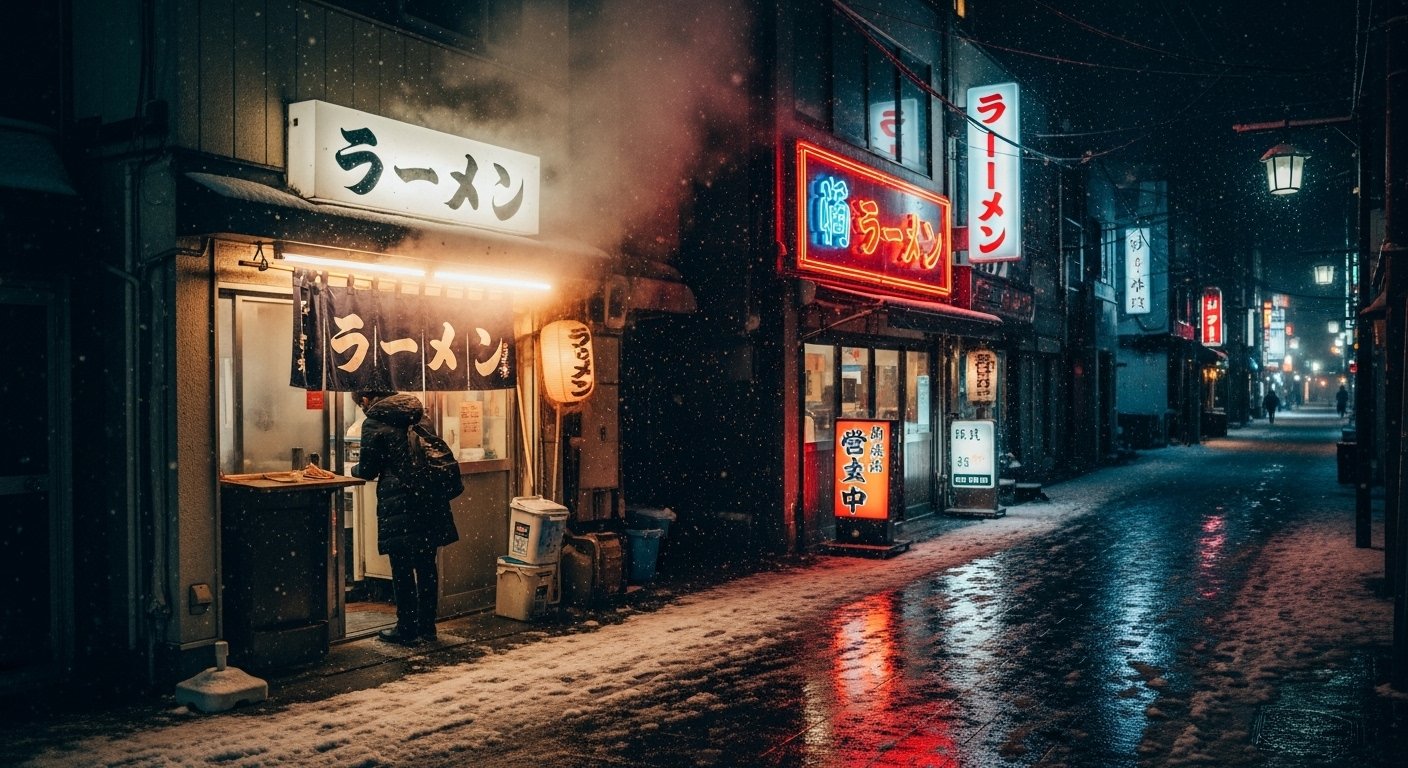
Finding Late-Night Ramen: Use Google Maps and filter for “Open Now” or check dedicated ramen blogs. Look for places with bright lights, a noren (split curtain) at the entrance, and often a visible ticket vending machine inside.
Ordering Process: Like gyudon chains, many ramen shops use ticket vending machines. The process is identical: insert money, select your ramen and any toppings, take your ticket, and hand it to the staff. You’ll usually be directed to an empty counter seat.
Budget: A bowl of ramen typically costs ¥800 to ¥1200, with toppings adding a bit more.

Family Restaurants: For Broader Menus
Chains like Denny’s, Gusto, and Jonathan’s are known as “family restaurants” (ファミリーレストラン – famiresu) in Japan. They offer a diverse menu, often including Japanese, Western, and Chinese dishes, and usually have longer operating hours than independent eateries, sometimes even 24/7. They also typically offer English menus.
What to Expect: A wide range of hot dishes, from spaghetti and hamburgers to tonkatsu (pork cutlet) and various rice bowls. They are a good option if you want something beyond noodles or gyudon.
Ordering Process: Standard sit-down restaurant service. English menus are often available; simply ask “Eigo no menyū wa arimasu ka?” (Is there an English menu?).
Budget: Slightly higher than konbini or gyudon chains, expect ¥800-¥1500+ per person for a main dish.

Navigating the Vending Machine (券売機 – Kenbaiki): Your Ordering Guide
Many budget-friendly, late-night establishments like ramen shops and gyudon chains use a ticket vending machine. Don’t be intimidated; it’s designed for efficiency and often helps bypass language barriers.
Step 1: Locate the Ticket Machine
Visual cue: This machine, often white, black, or red, will be prominently placed near the entrance, sometimes just inside the door. It usually has a large screen and physical buttons.
What to do: Head straight for it upon entering. Don’t wait to be seated.

Step 2: Look for English or Pictures
Visual cue: Scan the screen or buttons for an “English” (英語) button, or simply rely on the large, clear pictures of the food items. Most popular dishes will have an accompanying image.
What to do: If an English option exists, press it. Otherwise, use the pictures as your guide. The largest pictures usually correspond to the most popular or recommended dishes.
Step 3: Insert Cash
Visual cue: There will be slots for bills (紙幣 – shihei) and coins (硬貨 – kōka). You’ll typically see lights indicating where to insert your money.
What to do: Insert yen bills (¥1,000, ¥2,000, ¥5,000, ¥10,000) or coins (¥10, ¥50, ¥100, ¥500). The machine will display your credit.
🎯 Local Pro-Tip: Always carry some cash (yen notes and coins) when exploring Japan, especially for smaller establishments and vending machines. Many older machines do not accept credit cards or digital payments.
Step 4: Select Your Item(s)
Visual cue: Buttons will light up as you insert money. Pictures on the buttons help identify dishes. Common options might include “Ramen” (ラーメン), “Gyudon” (牛丼), “Large” (大盛 – oomori), “Regular” (並盛 – nami-mori), “Egg” (玉子 – tamago).
What to do: Press the button(s) corresponding to your desired meal and any add-ons. The price will be deducted from your inserted cash.
Step 5: Collect Tickets & Change
Visual cue: Once your selection is complete, a small paper ticket (or multiple tickets) will be dispensed from a slot, along with any change (お釣り – otsuri).
What to do: Take all tickets and your change. Do not leave the change behind.
Step 6: Hand Tickets to Staff
Visual cue: The staff will usually be behind a counter or visible in the dining area. They’ll be expecting you to hand over your tickets.
What to do: Find an empty seat at the counter or a table (if available) and present your ticket(s) to the staff. In many small ramen shops, you just hand it over to the chef behind the counter. They will then prepare your meal.

🇯🇵 Point & Speak: Essential Phrases for Late-Night Dining
Show this section to staff if you’re stuck. They can read the Japanese.
English: Is there an English menu?
英語のメニューはありますか?
(Eigo no menyū wa arimasu ka?)
English: Do you have any recommendations for warm food?
温かい食べ物のおすすめはありますか?
(Atatakai tabemono no osusume wa arimasu ka?)
English: What time do you close?
何時に閉まりますか?
(Nanji ni shimarimasu ka?)
English: I’d like this one (pointing at a picture/item).
これをお願いします。
(Kore o onegaishimasu.)
English: No, thank you (when offered toppings/extras).
結構です。
(Kekkō desu.)
💰 Price Breakdown: What to Expect for a Late-Night Meal
Here’s a general idea of what you can expect to pay for a warm, budget-friendly dinner after 9 PM. Prices are per person.
💰 Price Breakdown
| Meal Option | Estimated Cost (¥) |
| Convenience Store Oden/Hot Snack/Chuka Man | ¥300-800 |
| Convenience Store Instant Ramen + Drink | ¥400-700 |
| Gyudon (Beef Bowl) at Yoshinoya/Sukiya/Matsuya | ¥400-1000 |
| Ramen at a specialized shop | ¥800-1200 |
| Main dish at a Family Restaurant (e.g., Gusto) | ¥800-1500+ |
Prices verified as of January 2026. These are approximate and can vary by location and specific order.
📋 Quick Reference Card: Your Late-Night Survival Kit
Screenshot or print this section for easy access:
📋 Quick Reference Card: Late-Night Winter Warmers
- ✅ Best Options After 9 PM: Convenience Stores, Gyudon Chains (Yoshinoya, Sukiya, Matsuya), Ramen Shops (near stations/entertainment districts), Family Restaurants.
- ✅ Look For: 24/7 signs (24時間), bright lights, ticket vending machines (券売機), plastic food models.
- ✅ Warm Food Ideas: Oden, Chuka Man, Hot Snacks, Ramen, Udon, Gyudon.
- ✅ Language Help: Pointing, ticket machines with pictures/English, use phrases: “Eigo no menyū wa arimasu ka?” (English menu?), “Kore o onegaishimasu.” (This, please).
- ✅ Payment: Primarily cash for vending machines. Konbini and larger chains accept card/digital.
🎯 Local Pro-Tips: For Finding Late-Night Food
🎯 Local Pro-Tip: Use Map Apps Wisely: Google Maps is reliable. Search “restaurants” and then filter by “Open Now” (営業中 – eigyō-chū) and “Open 24 hours” (24時間営業 – 24-jikan eigyō). Similarly, Tabelog (tabelog.com/en/) and Gurunavi (gurunavi.com/en/japan/restaurants/) have English interfaces and filters for late-night openings.
🎯 Local Pro-Tip: Look for Red Lanterns and Steam: In entertainment districts, ramen shops often have red lanterns or brightly lit signs with ramen bowl illustrations. If you see steam rising from a doorway, it’s a good sign they’re serving hot food late.
🎯 Local Pro-Tip: Carry Small Bills and Coins: Vending machines for food tickets primarily accept cash. Having ¥1,000 bills and ¥100/¥500 coins will make your life much easier for late-night food runs.
🚫 Common Mistakes to Avoid
- ❌ Assuming all restaurants stay open late: This is the biggest pitfall. Plan ahead or stick to the reliable options listed above.
- ❌ Not carrying cash: While major stores accept cards, many smaller ramen or gyudon shops rely solely on cash for their vending machines.
- ❌ Hesitating to use visual cues: Don’t be shy about pointing to pictures or actual food items. It’s a universally understood communication method.
- ❌ Ignoring convenience stores: They are more than just snack shops; they are lifesavers for hot, budget-friendly meals.
Frequently Asked Questions
Are all convenience stores (konbini) open 24/7 in Japan?
While the vast majority of 7-Eleven, FamilyMart, and Lawson stores in urban and even many rural areas are open 24/7, there might be rare exceptions, particularly in very remote locations or smaller towns with low foot traffic. However, for most tourist routes and city centers, you can reliably count on them being open around the clock.
Can I use a credit card or mobile payment at late-night food spots?
It varies. Major convenience store chains (7-Eleven, FamilyMart, Lawson) almost universally accept credit cards, IC cards (like Suica/Pasmo), and various mobile payment apps. Larger gyudon chains and family restaurants often do too. However, many smaller ramen shops or independent eateries, especially those using ticket vending machines, may only accept cash. It’s always safest to carry some cash (yen) for late-night dining.
What if I have dietary restrictions (e.g., vegetarian) when looking for late-night warm food?
Finding vegetarian or vegan options late at night can be more challenging, as many broths and sauces contain meat or fish derivatives. Convenience stores might offer some vegetable-based instant noodles or plain rice balls (onigiri). Family restaurants tend to have more diverse menus with clearer allergen information. For specific needs, using a translation app to show staff “私は菜食主義者です” (Watashi wa saishoku shugisha desu – I am vegetarian) or “肉は食べられません” (Niku wa taberaremasen – I cannot eat meat) is recommended. Oden often has vegetarian items like daikon and eggs, but confirm the broth base if strict.
Is it rude to eat alone in a Japanese restaurant late at night?
Absolutely not. Eating alone, especially at counter-style ramen shops or gyudon chains, is very common and perfectly acceptable in Japan. It’s a quick, efficient way to enjoy a meal, and you’ll often see many solo diners. Do not feel self-conscious about it.
Conclusion
Navigating late-night dining in Japan, especially during a chilly winter and with a budget in mind, is straightforward once you know where to look. With the reliable options of 24/7 convenience stores, ever-present gyudon chains, and dedicated late-night ramen spots, you have a wealth of warm, budget-friendly, and surprisingly English-friendly options at your fingertips. Embrace the convenience, utilize visual cues and simple phrases, and you’ll successfully find a comforting dinner, no matter how late it gets.
Don’t let the clock dictate your hunger. Go out and enjoy Japan’s unique late-night culinary landscape.
Disclaimer
Information provided is for general guidance and was verified as of January 2026. Restaurant opening hours, menu items, and prices are subject to change without notice. Always verify current information, especially if traveling to specific or non-major metropolitan areas. While efforts are made to ensure accuracy, individual experiences may vary. This guide is not responsible for any personal injury, financial loss, or inconvenience incurred while following its advice.