*Images used in this article are for illustration only. They may not be directly related to the content.
Japan Winter Nomad Survival: Your Budget Blueprint for Warmth, Work & Community
I remember my first winter in Japan like it was yesterday. I’d arrived in autumn, enchanted by the changing leaves and crisp air. “This is going to be great!” I thought, smugly sipping matcha and enjoying the onsen towns. Then December hit. My tiny, adorable apartment in Tokyo – the one with the lovely view and the suspiciously low rent – transformed into a personal icebox. I’m talking frosty breath indoors, numb fingers trying to type, and a ¥30,000 electricity bill that made my jaw drop like a dropped mochi. I felt like I was camping indoors, but without the benefit of a warm campfire.
I tried everything: turning the AC heater on full blast (hello, ¥30,000 bill again), wearing three layers of clothes to bed, even attempting to make a fort out of futons. Nothing really worked, and the constant shiver started affecting my focus, my mood, and my wallet. I was a digital nomad, supposed to be living the dream, but I was just a cold, lonely expat counting yen and dreaming of central heating.
Over the past decade, I’ve seen countless fellow nomads and long-term travelers make the same mistakes. They come for the cherry blossoms, stay for the autumn leaves, and then get blindsided by the Japanese winter. But listen, it doesn’t have to be a miserable, expensive ordeal. I’ve learned the hard way, through frozen toes and empty bank accounts, how to not just survive, but thrive during the colder months here. I’m going to give you the honest, no-fluff, budget-friendly blueprint for staying warm, productive, and connected in Japan’s winter.
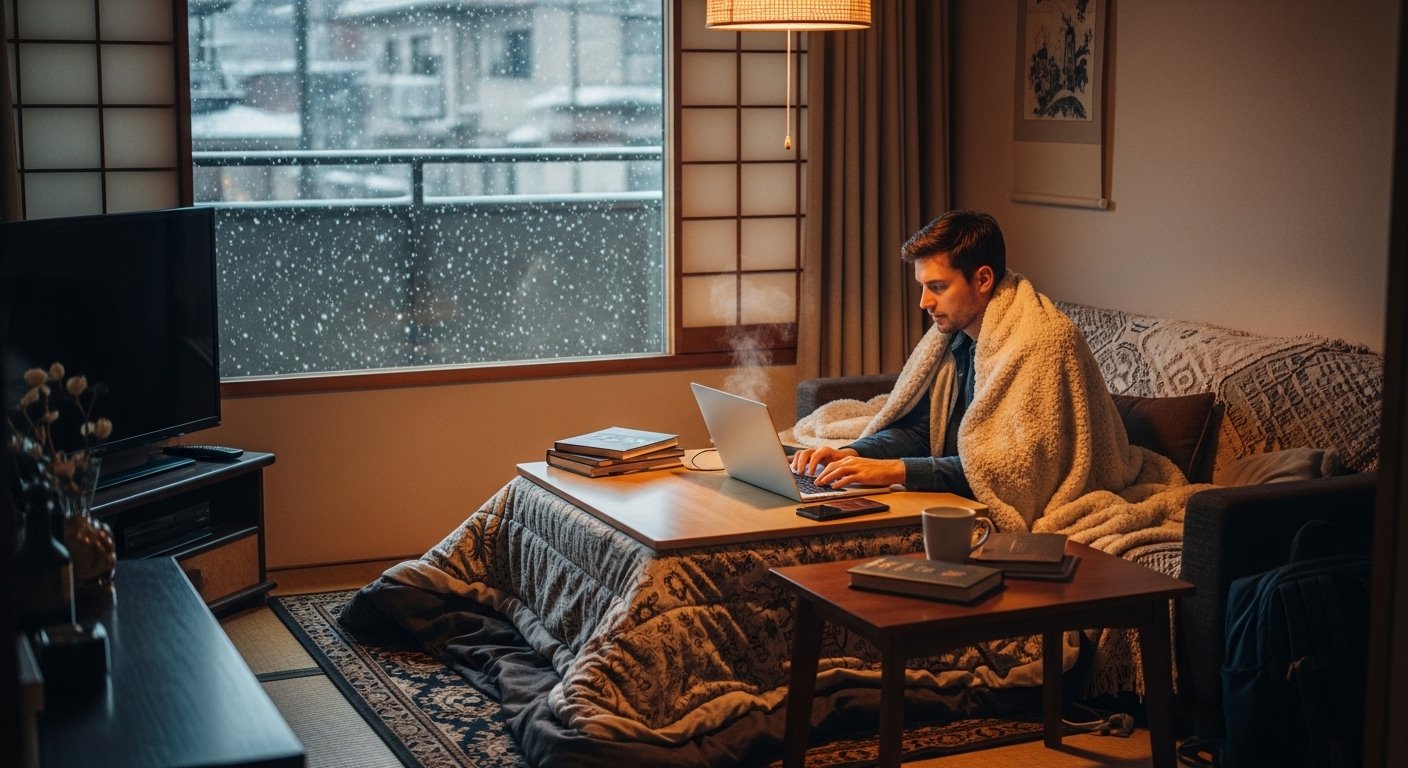
Table of Contents
The Real Struggle: Why Japan’s Winters Hit Different
If you’ve heard stories about cold Japanese homes, believe them. It’s not a myth. I’m not talking about a little draft; I’m talking about waking up and seeing your breath inside your own apartment. For most of my first year, I literally spent every night huddled under three duvets, convinced I was going to turn into an icicle. The fundamental issue is that Japanese houses tend to be very cold with poor insulation and no central heating. This isn’t a slight against Japanese architecture; it’s just a different building philosophy developed over centuries, often prioritizing airflow for humid summers. But for us digital nomads from countries with forced air heating, it’s a brutal shock.
This lack of insulation means heat escapes fast. You turn on your air conditioner (which doubles as a heater), and it blasts hot air for a while, making one small corner of your room feel okay. But the moment it cycles off, or you step out of that hot zone, you’re back in the arctic. This leads directly to the first major pain point: sky-high winter utility bills/heating costs. That ¥30,000 electricity bill I mentioned? It wasn’t a fluke. It was me desperately trying to warm a leaky sieve of an apartment with an inefficient AC unit.
Beyond the icy reality of home, there’s the equally frustrating challenge of difficulty finding warm, quiet, and affordable remote work spaces. You can’t just camp out in a cafe all day like in some other countries without getting side-eyed (or outright asked to leave) after a couple of hours. Libraries are great for quiet, but sometimes they’re not the warmest, and they often have strict rules about food and drink. Co-working spaces exist, but their daily or monthly fees can quickly eat into your budget, especially if you’re trying to save. I’ve definitely spent mornings hopping between coffee shops, trying to time my departures before I overstayed my welcome, all while my laptop battery dwindled.
And then, there’s the mental game. When it’s cold, dark, and damp outside, and your apartment feels like a freezer, it’s easy to slip into isolation. Feeling isolated or struggling to find social activities during cold months is a very real thing. You might not speak fluent Japanese, making it harder to connect. The vibrant street festivals of summer are gone, and everyone seems to hibernate. I remember one New Year’s, I found myself just staring at my heater, wishing for a friend to grab a warm nabe with. It wasn’t a pretty picture.
So, yes, the struggle is real. But after years of trial and error, I’ve got a system. Let’s dig in.
Surviving the Chill: Your Winter Nomad Action Plan
This isn’t just about throwing money at the problem. It’s about smart choices, local hacks, and a bit of cultural immersion.
Hack 1: Conquering the Cold at Home (Without Breaking the Bank)
Your apartment might be a thermal sieve, but we can patch it up and trick it into being cozy.
- Embrace Layers, Even Indoors: This sounds obvious, but you’d be surprised how many people just wear a t-shirt indoors. My go-to is Uniqlo’s Heattech. I own three sets: Extra Warm, Ultra Warm, and one regular. They’re fantastic, relatively inexpensive (a shirt starts around ¥1,500-¥2,000), and you can find them everywhere. Seriously, buy a few. Don’t just wear one sweater; wear a Heattech base layer, a long-sleeve shirt, and then a fleece. For your legs, Heattech leggings under sweatpants.
- Strategic Heating (When You Must):
- Air Conditioner: Your primary heating source. Use it smartly. Don’t leave it on all day. Heat your main living/working space for an hour or two, then turn it off or put it on a timer. Keep the door closed to that room. When you leave the house, turn it completely off.
- Kerosene Heaters (Kerosene ストーブ): These are common in rural Japan and provide intense, radiant heat. You buy kerosene at a gas station (sometimes a small delivery truck will even come by). BIG WARNING: You MUST vent the room regularly to avoid carbon monoxide buildup. Never sleep with one on. If you’re staying long-term, consider one – they can be cheaper to run than AC for raw heat. But they cost around ¥10,000-¥20,000 upfront.
- Gas Heaters (ガスファンヒーター): If your apartment has a gas hookup for one, these are amazing. Instant, powerful heat and often more efficient than AC. But again, you need the specific hookup, and they consume gas (another utility bill). Price: ¥15,000-¥30,000.
- Electric Blankets (電気毛布 – denki mofu) / Kotatsu (こたつ): These are your best friends.
- An electric blanket can be found for ¥3,000-¥8,000. It heats you, not the room, which is incredibly efficient. I drape mine over my futon or use it on my couch while working.
- A kotatsu is a low table with a heater underneath and a heavy blanket draped over it. It’s a game-changer. You slide your legs in, and it’s pure bliss. A basic kotatsu can be bought second-hand for ¥5,000-¥10,000 or new for ¥10,000-¥25,000. This is how I survived my coldest winters. You turn off the room heater and just live under the kotatsu.
- Draft Proofing Hacks:
- Window Film (窓用断熱シート – mado-you dannetsu sheet): This transparent film sticks to your windows and creates an extra insulating layer. It’s cheap (¥500-¥1,500 per roll) and makes a noticeable difference. I always put this up on my big window.
- Draft Stoppers (ドアすきまテープ – door sukima tape): Long fabric tubes or adhesive strips you put at the bottom of doors and windows to block cold air. ¥300-¥1,000 at 100-yen shops or hardware stores.
- Thick Curtains (厚手のカーテン – atsude no ka-ten): If your apartment has thin curtains, invest in some thicker, thermal ones. They trap a lot of heat. Expect to pay ¥3,000-¥10,000 for a decent pair.
- Heat Packs (Kairo – カイロ): These small, air-activated heat patches (around ¥100 for a pack of 10) are lifesavers for outdoor excursions or even just keeping specific body parts warm indoors. Stick them to your lower back or stomach. Don’t put them directly on bare skin!
Hack 2: Finding Your Warm & Productive Remote Haven
Your apartment might not be ideal for 8 hours of focused work, and that’s okay. Japan has options, if you know where to look.
- Public Libraries (図書館 – toshokan): My absolute favorite. They are almost always warm, quiet, and free. Many have designated study areas with power outlets. The downside is usually no food/drink beyond water, and you can’t make calls. But for deep work, they are perfect. Just check opening hours; they often close earlier than cafes and might be closed on specific weekdays.
- Cafes (カフェ): Yes, you can work from cafes, but with etiquette.
- Chain Cafes: Starbucks, Doutor, Tully’s, Excelsior Cafe. They’re warm, have Wi-Fi (sometimes spotty), and power outlets. Buy a drink every 1.5-2 hours. Don’t spread out too much, and don’t take up a prime table for too long, especially during peak hours. Expect to spend ¥500-¥800 per drink.
- Manga Kissa / Internet Cafes (漫画喫茶 / インターネットカフェ): These are surprisingly good for focused work. You get a private booth, comfy chair, sometimes a monitor, free drinks bar, and decent Wi-Fi. They’re warm and quiet, but the vibe can be a bit…unique. Prices typically range from ¥500-¥1,000 for 3 hours. Some offer overnight packs.
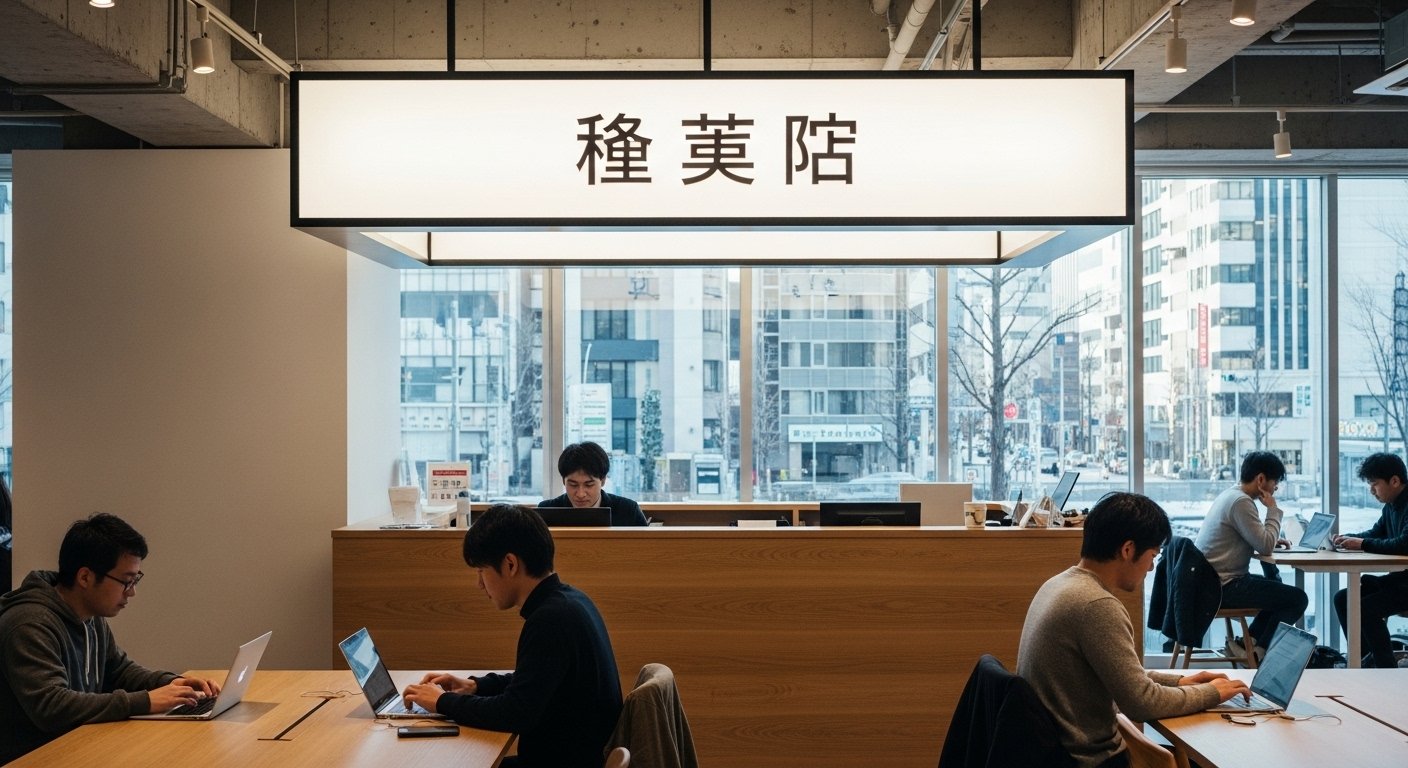
- Co-working Spaces (コワーキングスペース): These are purpose-built for productivity. They are reliably warm, have fast Wi-Fi, ergonomic chairs, and often free coffee/tea. Look for daily passes (usually ¥1,500-¥3,000) or weekly/monthly deals if you’ll be there a lot. Some major chains like WeWork have locations in bigger cities, but also look for smaller, local operations. I’ve often found great deals on trial memberships for ¥500 for a day.
- Department Store Cafeterias / Food Courts (デパートの食堂街 / フードコート): Not ideal for calls, but surprisingly good for casual work. They’re warm, have lots of seating, and you can grab a cheap meal. Wi-Fi can be hit or miss. This is my “backup plan” if everywhere else is full.
Hack 3: Beating the Winter Blues: Community & Connection
Isolation can creep up on you when it’s cold. Don’t let it. Being proactive about finding people is key.
- Meetup Groups (Meetup.com): This is where I found my first friends in Japan. Search for groups related to your interests: language exchange, hiking (yes, even in winter, some groups go!), board games, photography, expat gatherings. There are hundreds of active groups in major cities. Most events are free or low cost (¥500-¥1,000 for a shared meal or event fee).
- Language Exchange (言語交換 – gengo kōkan): Websites like HelloTalk or Tandem are great for connecting online, but many cities also have in-person language exchange meetups. It’s a fantastic way to practice Japanese and meet locals or other expats. Often held in cafes, so you get warmth and company.
- Local Events & Festivals (お祭り – omatsuri): Winter still has its charm! Look for winter illuminations, New Year’s events (Oshogatsu), snow festivals in northern regions, and local shrine events. Even if you don’t understand everything, just being out among people, experiencing the culture, makes a huge difference. Check local city websites or tourism boards.
- Volunteer Work (ボランティア活動 – borantia katsudō): This is a goldmine for meeting like-minded people. Look for environmental groups, animal shelters, or even helping out at local community centers. You’re giving back, practicing Japanese (if you want), and making genuine connections. Google “volunteer Tokyo” (or your city).
- Gyms or Hobby Classes (ジム / 習い事 – narai-goto): Join a local gym (expect ¥5,000-¥10,000/month) or take up a class – pottery, cooking, martial arts, flower arranging (ikebana). Shared activities naturally lead to friendships. I joined a local kendo club years ago, and those guys became my family.
- Sento & Onsen (銭湯 / 温泉): Nothing beats the winter chill like a long, hot soak. Local public bathhouses (sento) are cheap (around ¥500) and a quintessential Japanese experience. Onsen (hot springs) are a bit pricier and often involve travel, but a day trip to a nearby onsen town is a perfect weekend escape and a great way to warm up completely.
The ‘Real’ Cost of Winter Nomad Life: A Budget Breakdown
Let’s get specific about how much these hacks might save you compared to just cranking the AC. These are estimates for a single person in a typical small Japanese apartment (1R/1K).
| Category | Item/Strategy | Estimated Initial Cost (¥) | Estimated Monthly Running Cost (¥) | Notes |
|---|---|---|---|---|
| **Warmth at Home** | AC Heating (default, inefficient) | 0 | 15,000 – 30,000+ | High if used constantly, especially in poorly insulated homes. |
| Heattech Clothing (3 sets) | 6,000 – 10,000 | 0 | One-time investment, lasts years. Essential. | |
| Electric Blanket / Kotatsu | 3,000 – 15,000 | 500 – 2,000 | Heats *you*, not the room. Far more efficient. | |
| Draft Proofing (Film, Tape) | 1,000 – 3,000 | 0 | Small upfront cost, big long-term savings on heating. | |
| **Work Spaces** | Working from (Cold) Home | 0 | (Increased electricity if heating) | Impacts productivity/mood. |
| Public Library | 0 | 0 | Free, warm, quiet. My top recommendation. | |
| Cafes (3-4 times/week) | 0 | 6,000 – 10,000 | Cost of coffee/tea. Watch etiquette. | |
| Co-working Space (occasional daily pass) | 0 | 4,500 – 9,000 | For 3 days a month (¥1,500-¥3,000/day). | |
| **Community & Social** | Meetup/Language Exchange | 0 | 1,000 – 4,000 | Cost of a drink or small event fee. |
| Sento (public bath) | 0 | 2,000 – 4,000 | 4-8 visits a month (approx. ¥500/visit). | |
| Local Classes/Gym | 0 – 5,000 | 5,000 – 10,000 | Gym membership or hobby class fee. |
Total Potential Savings: By strategically investing in a kotatsu/electric blanket and focusing on free/cheap workspaces, you could easily cut your heating bill by ¥10,000-¥20,000 per month. The upfront costs for insulation and warmth items pay for themselves quickly.
Common Pitfalls & How to Dodge Them
I’ve made every single one of these mistakes, so learn from my pain!
- “I’ll Just Power Through It” Mentality: This was my first mistake. I thought I was tough. Nope. You’ll be miserable, unproductive, and likely end up with a huge utility bill anyway from desperate, inefficient heating. Invest in the simple warmth hacks.
- Underestimating Utility Bills: Don’t just look at rent. Ask about average winter utility costs if you’re signing a longer lease. Remember, you might pay for electricity, gas, and water separately. My first ¥30,000 electric bill came as a complete shock because I just assumed heating wouldn’t be that bad.
- Relying Solely on the AC Unit: Yes, it heats, but it’s often designed for supplementary heating or for small, well-insulated spaces. It dries out the air and can make your electricity meter spin like a top. Use it to take the initial chill off, then maintain warmth with personal heaters (kotatsu, electric blanket) and layers.
- Neglecting Your Social Life: It’s easy to retreat into your shell when it’s cold. Don’t! Make an effort to attend at least one social event a week. Even if it’s just a language exchange over coffee, it breaks the isolation.
- Not Understanding Japanese Appliance Instructions: My first kerosene heater was a mystery. I just hit buttons and hoped. Get Google Translate’s camera function ready, or better yet, ask a Japanese friend or your landlord for help. Knowing how to properly use and maintain your heating appliances (and especially their safety features) is crucial.
- Forgetting About Your Feet: Japanese homes often have cold floors. Wear thick socks, slippers (suripa), or even room boots. Your feet will thank you.
🇯🇵 Point & Speak
Show this to staff at a hardware store or an appliance shop when looking for warmth items:
English: I am looking for something to make my room warmer, but I want to save on electricity bills. Do you have any recommendations?
電気代を節約しながら、部屋を暖かくしたいです。何かおすすめはありますか?
(Denkidaio setsuyaku shinagara, heya o attakaku shitai desu. Nanika osusume wa arimasu ka?)
English: Is there a warm, quiet place to work with Wi-Fi nearby?
近くにWi-Fiがあって、暖かくて静かに仕事ができる場所はありますか?
(Chikaku ni Wi-Fi ga atte, attakakute shizuka ni shigoto ga dekiru basho wa arimasu ka?)
🎯 Insider Tip: For serious warmth and budget control, look for apartments that explicitly mention “二重窓” (ni-jū mado – double-paned windows) or “断熱材” (dannetsu-zai – insulation) in their listings. These are rare but make an incredible difference. If you can’t find one, your second-best bet is an apartment with good sun exposure (南向き – *minami-muki* – south-facing) for passive solar heating during the day. It’s not a lot, but every bit helps!
FAQ
The Japanese winter can be tough, especially when you’re trying to balance work, a budget, and sanity in a foreign country. I’ve shivered through enough of them to tell you that with a bit of foresight and these specific hacks, you can absolutely conquer it. Don’t let the cold stop you from experiencing the unique beauty of Japan’s colder months. Bundle up, get strategic, and go find your cozy corner. You got this.