*Images used in this article are for illustration only. They may not be directly related to the content.
Japan Winter Nomads: Stay Warm, Active, and Connected Affordably
Winter in Japan presents a unique set of challenges for international nomads. The charm of snow-dusted temples can quickly fade when faced with cold, often poorly insulated accommodations, the sting of high heating bills, limited outdoor activities, and the pervasive feeling of isolation.
You’re not alone if you’ve felt the chill seep into your bones or wondered how to keep your utility costs from spiraling. Navigating these cold months effectively requires practical strategies beyond just layering up.
This comprehensive guide, your Japan Local Fixer, is designed to remove friction. We’ll equip you with actionable life hacks to stay warm affordably, discover engaging indoor and outdoor activities, and build meaningful connections within the community. Thrive through the Japanese winter, rather than simply enduring it.
Table of Contents
Battling the Chill: Affordable Heating & Warmth in Japanese Homes
One of the primary pain points for international nomads in Japan during winter is the cost and effectiveness of heating. Many Japanese apartments, particularly older ones, are not built with central heating or robust insulation. This means relying on inefficient air conditioning units for warmth, leading to high utility bills and often still-cold rooms.
The Problem: Unwieldy Utility Bills & Ineffective Heating
During December to February, relying heavily on air conditioning for heating can push your electricity bill for a single person from ¥8,000 to ¥15,000 per month, sometimes higher. Gas bills, if you have a gas heater or hot water, can add another ¥4,000-¥8,000. These figures quickly add up, making affordable heating a top priority for any winter in Japan nomad.
The Solution: Strategic Personal Heating Power-Ups
Instead of trying to heat an entire poorly insulated space, focus on personal heating solutions. These are often more energy-efficient and directly address your need for warmth.
1. The Kotatsu: Your Cozy Winter Hub
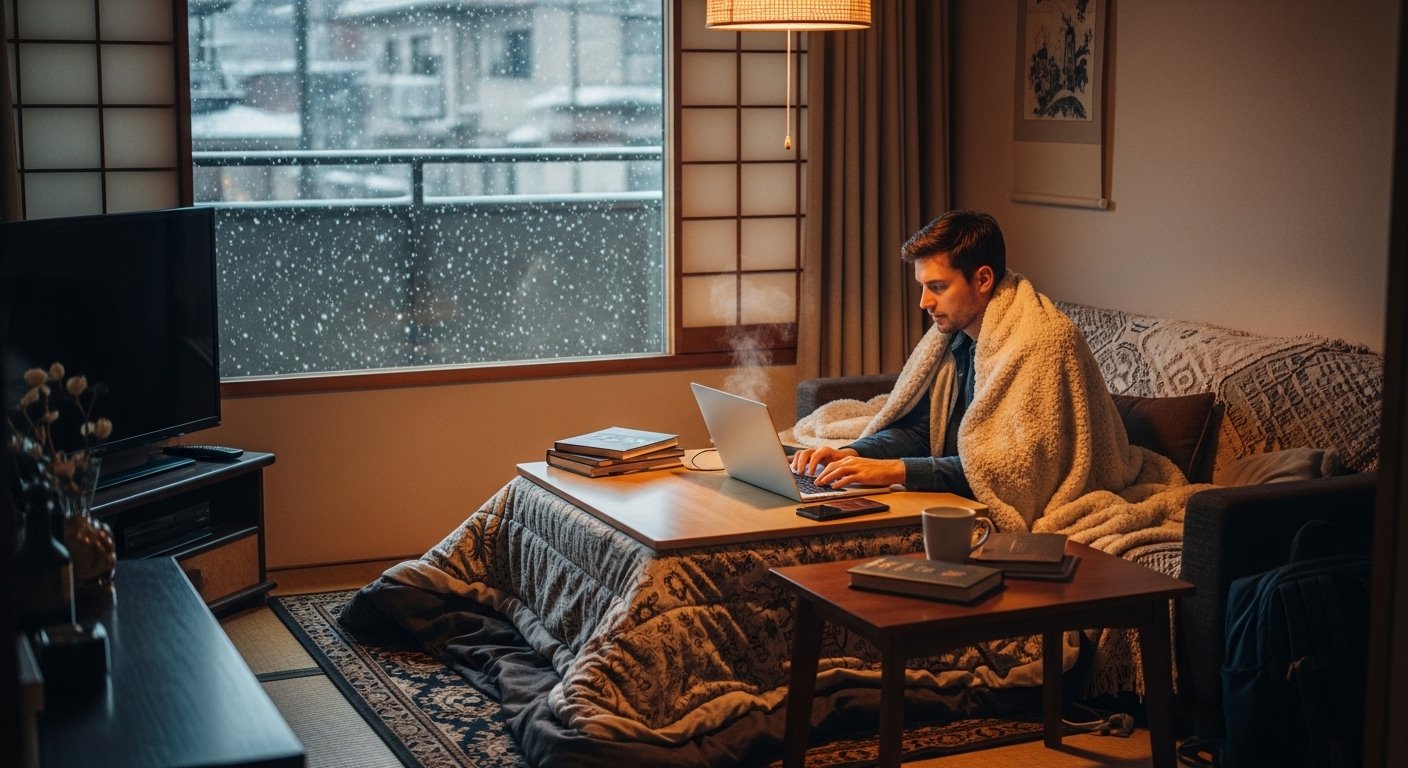
A kotatsu (炬燵) is a low table with an electric heater underneath, covered by a heavy blanket. You sit on the floor (often on cushions or zabuton) with your lower body under the blanket. It creates a warm, inviting zone and is a quintessential Japanese winter experience.

Why it works: It heats only the space you occupy, using significantly less energy than heating an entire room. It also naturally encourages social interaction, as family and friends gather around it.
Where to buy: Nitori, Amazon Japan, or second-hand stores like Hard Off.
2. Electric Blankets & Carpets: Personal Warmth On Demand
Electric blankets (電気毛布 – denki mōfu) and electric carpets (電気カーペット – denki kāpetto) are energy-efficient for personal use. Drape a blanket over your futon or bed, or place a carpet under your desk or in your primary sitting area.

Why it works: Direct heat to your body means you feel warmer without needing to raise the ambient room temperature significantly. They are compact and easy to store in warmer months.
Where to buy: Electronics stores such as Bic Camera and Yodobashi Camera, or home centers.
3. Kerosene Heaters: Powerful & Cost-Effective (with caveats)
Kerosene heaters (石油ストーブ – sekiyu sutōbu) are known for their strong, immediate heat output and are generally more cost-effective than electricity for heating a larger space. However, they come with significant safety and logistical considerations.
🎯 Local Pro-Tip: Before purchasing a kerosene heater, ALWAYS check your rental agreement or consult your landlord. Many newer apartments or buildings may prohibit their use due to fire risk or insurance policies.
💰 Price Breakdown: Essential Winter Warmth Gear
💰 Price Breakdown: Essential Winter Warmth Gear
| Item | Cost (Approx.) |
| Basic Kotatsu Set (table + heater) | ¥10,000-¥30,000 |
| Kotatsu Blanket (separate) | ¥3,000-¥10,000 |
| Electric Blanket | ¥3,000-¥15,000 |
| Electric Carpet | ¥5,000-¥25,000 |
| Kerosene Heater (new) | ¥10,000-¥30,000 |
| Kerosene Container (poly tank) | ¥1,000-¥2,000 |
| Kerosene (per liter) | ¥100-¥120 |
Prices verified as of January 2026. Costs may vary based on brand, size, and store.
Visual Step-by-Step: Acquiring Kerosene in Japan
If you’ve confirmed you can safely use a kerosene heater, here’s how to get the fuel:
Step 1: Get a Kerosene Container (ポリタンク – poritanku)
Visual cue: Look for sturdy plastic tanks, typically red or blue, with a capacity of 18-20 liters and a pouring spout. They are usually found in home centers (e.g., Kohnan, Cainz Home).
What to do: Purchase a dedicated kerosene poly tank. Do not use containers meant for water or other liquids, as residue can be dangerous.

Step 2: Locate a Gas Station that Sells Kerosene
Visual cue: Most major gas stations (Eneos, Idemitsu, etc.) sell kerosene. Look for signs with the kanji ‘灯油’ (tōyu) or an area with smaller, often separate pumps or an attendant dedicated to kerosene sales, sometimes featuring a distinct smell.
What to do: Drive or walk your poly tank to the gas station. Many will have self-service kerosene pumps, but some may require an attendant to help you.

Step 3: Fill Your Kerosene Container
Visual cue: The kerosene pump will be clearly labeled ‘灯油’. Ensure your poly tank is stable and on a flat surface before filling.
What to do: Follow the instructions at the pump. If there’s an attendant, they will guide you or fill it for you. Pay at the designated counter or pump.
🎯 Local Pro-Tip: Always store kerosene in a well-ventilated area, away from direct sunlight and heat sources. Never store it inside your living space. A balcony or outdoor storage shed is ideal.
Common Mistakes: Kerosene Heater Use
- Ignoring Ventilation: Kerosene heaters produce carbon monoxide. Always ensure adequate ventilation by cracking a window or door, even if it feels counterintuitive to staying warm.
- Overfilling: Do not fill the heater’s tank beyond the marked maximum line.
- Running While Sleeping: Never operate a kerosene heater while you are asleep or out of the room.
- Ignoring Rental Rules: As mentioned, check your rental agreement. Breach of contract could lead to fines or eviction.
Pro-Tips for General Warmth & Savings
- Layer Up: Invest in thermal wear like Uniqlo HEATTECH. Multiple thin layers trap heat more effectively than one thick layer.
- Block Drafts: Use adhesive draft stoppers or tape around windows and doors. Thick curtains can also help insulate.
- Warm Food & Drink: Embrace hot tea, ramen, nabe (hot pot), and other warming Japanese dishes.
- Hot Baths: Japanese bathrooms often have powerful heaters. A long, hot bath can be a great way to warm up completely.
Embracing Winter: Engaging Hobbies & Activities
The cold weather can limit traditional outdoor activities, leading to a sense of cabin fever. However, winter in Japan nomad life doesn’t mean hibernation. Japan offers a rich array of indoor and seasonal experiences to keep you engaged and active.
The Problem: Limited Outdoor Activities & Cabin Fever
When temperatures drop and daylight shortens, it’s easy to fall into a routine of staying indoors. This can lead to boredom and a lack of stimulation. The key is to shift your perspective and explore what winter uniquely offers.
The Solution: Discovering Indoor & Seasonal Joys
1. Public Libraries & Community Centers: Free & Warm Hubs
Public libraries (図書館 – toshokan) and community centers (公民館 – kōminkan) are excellent resources. They offer free, heated spaces ideal for reading, studying, or quiet work. Libraries often require local registration (with proof of address) to borrow books, but generally, anyone can use the premises for on-site reading and work.

Beyond books: Community centers often host a variety of local events, classes (like cooking or calligraphy), and workshops, some of which may be free or low-cost. Check your local city government website for schedules.
2. Onsen (Hot Springs): The Ultimate Winter Warmth
There’s nothing quite like sinking into a steaming onsen bath when the air is crisp, especially a rotenburo (outdoor bath) surrounded by snow. Onsen are an iconic Japanese experience and a perfect antidote to winter’s chill.

Day-use options: Many onsen resorts offer day-use options (日帰り温泉 – higaeri onsen) without requiring an overnight stay. Costs typically range from ¥800 to ¥2,500.
Popular regions: Look into Hakone, Atami, Beppu, Hokkaido, and Tohoku for renowned onsen experiences. Consider linking these trips with Navigating Japanese Public Transportation in Winter for travel tips.
3. Indoor Hobbies & Cultural Exploration
- Café Hopping: Explore Japan’s vibrant café culture. Many offer cozy atmospheres perfect for remote work or relaxation.
- Museums & Galleries: Winter is an ideal time to visit Japan’s world-class museums and art galleries, providing cultural enrichment and a warm escape.
- Cooking Classes: Learn to make Japanese cuisine, often incorporating seasonal winter ingredients.
- Arcades & Karaoke: For a more energetic indoor activity, Japanese arcades and karaoke boxes offer hours of entertainment.
🎯 Local Pro-Tip: Check the Japan National Tourism Organization (JNTO) website for a comprehensive list of winter activities, including illuminations and unique winter festivals. These seasonal events offer great photo opportunities and a chance to experience Japanese culture.
Forge Connections: Community & Combating Isolation
The colder months can heighten feelings of isolation, especially for nomads in a foreign country. Meeting people and building a support network is crucial for well-being during winter in Japan nomad life. Luckily, Japan offers various avenues for connecting with both international residents and locals.
The Problem: Feeling Isolated & Difficulty Meeting People
Language barriers, cultural differences, and simply not knowing where to start can make it challenging to meet new people. Winter’s shorter days and colder temperatures can exacerbate this, making it harder to venture out and engage.
The Solution: Building Your Winter Tribe
1. Meetup.com: Your Gateway to Groups
Meetup.com is a powerful platform widely used across major Japanese cities (Tokyo, Osaka, Kyoto, Fukuoka, Sapporo). You can find groups for nearly any interest: language exchange, hiking (even winter hikes!), board games, photography, coding, or just social gatherings.

Why it works: It facilitates connections based on shared hobbies and interests, making initial interactions easier. Many groups are specifically designed for international residents, providing an immediate sense of community.
2. Community Centers & Local Events (Revisited)
Beyond quiet study spaces, community centers (公民館 – kōminkan) are hubs for local engagement. Many offer classes (e.g., Japanese calligraphy, flower arranging, traditional dance) or host cultural events that are open to residents. Participating is a direct way to meet locals with shared interests.
Finding events: Check local city hall websites or community boards for event listings. Look for “国際交流会” (kokusai kōryūkai – international exchange events).
3. Language Exchange & Study Groups
Learning Japanese is a natural bridge to connection. Seek out language exchange partners (online or in person) or join a study group. Many cafes host regular language exchange meetups.
Online Resources: Websites and apps like HelloTalk or Tandem can connect you with Japanese speakers eager to learn English (or another language).
4. Volunteer Opportunities
Volunteering is an excellent way to give back to the community, practice Japanese, and meet like-minded individuals. Search for local NPOs or charities that welcome international volunteers. This could range from environmental clean-ups to helping at local events.
🎯 Local Pro-Tip: Don’t be afraid to initiate conversations, even with limited Japanese. A simple “Konnichiwa” and a smile can go a long way. Use translation apps if needed, but show genuine effort. Most Japanese people appreciate the attempt.
🇯🇵 Point & Speak: Essential Winter Phrases
Navigating daily life, especially when purchasing items or asking for help, becomes smoother with a few key phrases. Show this section to staff if you’re stuck; they can read the Japanese.
🇯🇵 Point & Speak
Show this section to staff if you’re stuck. They can read the Japanese.
English: It’s cold, so I want to buy a heater.
寒いので、ヒーターを買いたいです。
(Samui node, hītā o kaitai desu.)
English: Where can I buy kerosene?
灯油はどこで買えますか?
(Tōyu wa doko de kaemasu ka?)
English: Do you have an electric blanket?
電気毛布はありますか?
(Denki mōfu wa arimasu ka?)
English: Are there any events or meetups for international people?
外国人向けのイベントや交流会はありますか?
(Gaikokujin-muke no ibento ya kōryūkai wa arimasu ka?)
English: Can I use this library for studying?
この図書館で勉強できますか?
(Kono toshokan de benkyō dekimasu ka?)
English: This room is cold.
この部屋は寒いです。
(Kono heya wa samui desu.)
Frequently Asked Questions
How can I significantly reduce my heating bill in a Japanese apartment during winter?
Focus on personal heating rather than trying to warm an entire poorly insulated room. Invest in a kotatsu, electric blanket, or electric carpet. Combine these with thermal layering (like Uniqlo HEATTECH) and blocking drafts around windows and doors. This strategy drastically cuts down on the energy consumption of inefficient air conditioning units.
Are kerosene heaters safe for use in Japanese apartments?
Kerosene heaters are powerful and cost-effective but require strict adherence to safety guidelines. They produce carbon monoxide, so constant ventilation (cracking a window) is mandatory. Crucially, always check your rental agreement or consult your landlord before purchasing one, as many apartments prohibit their use due to fire risk or insurance policies.
What are good indoor activities in Japan during winter to avoid cabin fever?
Public libraries and community centers offer free, heated spaces for reading and studying, often hosting local events. Onsen (hot springs) are a quintessential winter activity for warmth and relaxation. Additionally, explore Japan’s extensive museum and gallery scene, enjoy cafe hopping, or immerse yourself in indoor entertainment like cooking classes, arcades, or karaoke.
How can a nomad meet other international residents or locals in Japan during winter?
Meetup.com is a robust platform for finding groups based on shared interests in major cities. Community centers frequently host international exchange events (国際交流会). Engaging in language exchange with Japanese speakers or volunteering for local causes are also effective ways to build connections and integrate into the community.
Conclusion
Winter in Japan as a nomad doesn’t have to be a period of discomfort or isolation. By implementing practical heating strategies, actively seeking out engaging activities, and proactively connecting with communities, you can transform the colder months into a rich and rewarding experience. Embrace the unique aspects of Japanese winter, from the warmth of a kotatsu to the tranquility of a snowy onsen.
Stay warm, stay wise, and stay connected. Your Japanese winter adventure is yours to define.
If you have your own winter hacks or community tips, share them below!
Disclaimer
All prices mentioned are estimates and subject to change. Kerosene heater use carries inherent risks; always prioritize safety, follow manufacturer instructions, and adhere to local rental regulations. This guide provides general information, and individual circumstances may vary. Consult local resources for specific regulations and safety protocols.