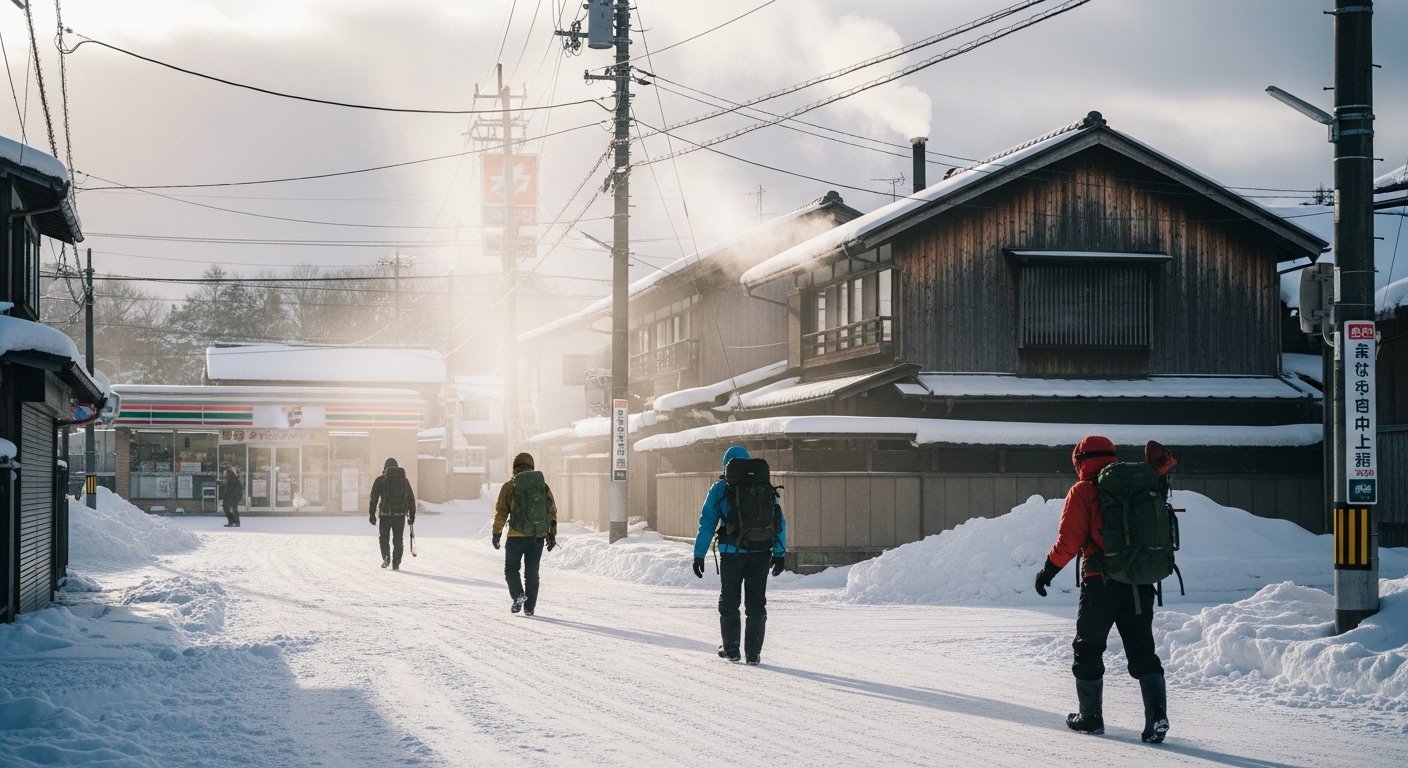
*Images used in this article are for illustration only. They may not be directly related to the content.
Early Morning Winter Transport Safety: Navigate Icy Platforms & Sudden Delays in Japan
Navigating Japan’s hyper-efficient public transport system is usually seamless, a marvel of punctuality. However, early winter mornings introduce unique challenges. The crisp air can turn station platforms and stairs into treacherous, icy surfaces, and unexpected snow or freezing rain can lead to sudden train delays or even cancellations. These disruptions, often announced rapidly in Japanese, can leave international visitors feeling stranded and uncertain, especially with language barriers.
As your Japan Local Fixer, this comprehensive guide cuts through the confusion. We’ll equip you with practical strategies and essential Japanese phrases to keep you safe, warm, and on track. Understanding how to proactively prepare for these issues and react effectively is crucial for a stress-free winter journey across Japan.
Table of Contents
- The Challenge: Early Morning Winter Transport in Japan
- Preventing Slips: Navigating Icy Platforms & Stairs Safely
- Understanding & Managing Unexpected Delays
- Staying Warm & Safe When Stranded
- Essential Japanese Phrases for Winter Transport Issues
- Common Mistakes to Avoid
- Quick Reference Card: Your Winter Transport Safety Checklist
- Emergency Contacts
- Frequently Asked Questions
The Challenge: Early Morning Winter Transport in Japan
While Japan’s transport system is legendary for its efficiency, winter conditions, particularly in the early morning hours, introduce several pain points for international visitors. These challenges range from physical safety risks to communication breakdowns and logistical hurdles.
Slipping Hazards: The Silent Threat of Icy Platforms
One of the most immediate dangers is the risk of slipping and falling on icy or snowy station platforms and stairs. Early morning temperatures often drop below freezing, creating black ice – a thin, transparent layer of ice that is nearly invisible. This risk is present even in major cities like Tokyo, especially on outdoor platforms or bridges connecting station sections. Regions prone to heavier snow, such as Hokkaido, Tohoku, Hokuriku, and mountain areas in Kanto/Kansai, face even more severe conditions.
A fall can lead to injury, disrupt travel plans, and require unexpected medical attention, impacting your travel budget and schedule. Unlike familiar winter environments, the subtle nature of black ice on well-maintained but still exposed surfaces can catch visitors off guard.
Understanding the Unspoken: Language Barriers During Delays
Japan’s rail network is highly interconnected; a delay on one line can create ripple effects across multiple transfer points. During these situations, sudden announcements about train delays, cancellations, or route changes are typically made rapidly in Japanese. While major stations increasingly offer English information on digital boards, smaller or regional stations, particularly in the early morning before 7 AM, might have limited English support. This makes it difficult to grasp the severity or duration of a delay, leaving you confused and unable to make informed decisions.
Stranded and Cold: The Comfort Challenge
Being unexpectedly stranded at a cold, isolated station or transfer point for extended periods due to transport issues is a significant discomfort. Unlike major hubs with many amenities, smaller stations can be sparse, especially outside of peak hours. Waiting in freezing temperatures without adequate shelter can quickly become unpleasant and even pose health risks.
Navigating the Unknown: Finding Alternatives
When primary routes are disrupted, quickly identifying and navigating alternative transport options becomes a struggle. This requires understanding the local transport network, knowing which apps to trust for real-time information, and potentially communicating with staff to confirm replacement services like ‘daikō basu’ (replacement buses). Without prior knowledge, this can feel like an impossible task.
Preventing Slips: Navigating Icy Platforms & Stairs Safely
Your safety on icy surfaces starts before you even leave your accommodation. Proactive measures can significantly reduce the risk of a fall.
Footwear First: Your Foundation for Safety
Even if you anticipate primarily using indoor transport, always assume outdoor exposure. Invest in and wear waterproof, non-slip footwear. Look for shoes with good tread or rubber soles designed for traction on wet or icy surfaces. Regular sneakers may not provide adequate grip.
Specialized Anti-Slip Gear: The Local Advantage
In regions with heavy snowfall, like Hokkaido or the Japan Sea coast, specialized anti-slip footwear attachments are readily available. These include “slip-on spikes” or “yakkan” (雪ん子 – ‘yukinko’, meaning ‘snow child’ but also a common term for snow grips) that you can easily put over your regular shoes for extra grip. They are a worthwhile investment for winter travel.
💰 Price Breakdown: Anti-Slip Gear
| Item | Cost (Approx.) | Where to Buy |
| Slip-on shoe spikes / Yakkan | ¥1,000-3,000 | Convenience stores, drugstores, shoe shops, hardware stores in snowy regions |
Prices verified as of January 2024. Availability may vary by region and store.
🎯 Local Pro-Tip: Even if you don’t buy specialized gear, scuff the soles of your shoes lightly on rough surfaces to improve grip if they feel too smooth. Every bit of traction helps.
Observe Your Surroundings: Visual Cues of Safety Efforts
Japanese station staff are diligent. During freezing conditions, they frequently spread anti-slip sand or de-icing agents. Keep an eye out for these visual cues:
Step 1: Look for Sand Buckets and Piles
Visual cue: You’ll see yellow or red buckets/piles of sand or de-icing salt (融雪剤 – ‘yūsetsuzai’) placed strategically on platforms, near stairs, and on walkways. Small shovels are often nearby. This indicates that staff are actively managing icy conditions.
What to do: Be aware that these areas may still be slippery. If the sand hasn’t been spread yet, or if it’s been recently applied and not fully effective, proceed with caution.

Step 2: Identify Warning Signs
Visual cue: Look for red triangular ‘注意’ (Chūi – Caution) or ‘滑りやすい’ (Suberi Yasui – Slippery) signs on the ground or on stands near potentially icy or wet areas. Yellow/black striped warning tape or ‘立ち入り禁止’ (Tachiiri Kinshi – No Entry) signs may also mark off hazardous spots.
What to do: These signs are clear warnings. Do not ignore them. Alter your path or slow your pace significantly.

Walk with Caution: Mindful Movement
Even with good footwear and visible safety efforts, maintain a careful gait. Take shorter, slower steps, avoiding sudden movements. Keep your hands out of your pockets to maintain balance. Use handrails on stairs whenever possible, even if they appear clear of ice. Your personal attention to movement is your best defense.
Understanding & Managing Unexpected Delays
The punctuality of Japanese trains is famous, but winter conditions can challenge even this reputation. Being prepared to handle delays is essential.
The Language Barrier: Why Announcements Can Be Confusing
During disruptions, station announcements are rapid, packed with specific terminology, and primarily in Japanese. While major stations have improved English signage, the nuances of a delay – its cause, estimated duration, and recommended alternatives – are often lost in translation. This is where your preparedness becomes key.
Your Information Arsenal: Tools for Real-Time Updates
Do not rely on a single source of information. Arm yourself with multiple tools:
-
Official Railway Company Websites (English Sections)
Major railway companies like JR East, JR West, and Tokyo Metro provide real-time delay information on their official websites, often with dedicated English sections or “Operation Status” pages. These are generally the most reliable for official announcements.
- JR East Operation Information (Kanto Region)
- JR West Operation Information (Kansai Region)
- Tokyo Metro Real-time Information
🎯 Local Pro-Tip: Before you leave, check the Japan Meteorological Agency (JMA) for local weather forecasts. Knowing if snow or freezing rain is expected can help you anticipate potential disruptions.
-
Transit Planning Apps
Apps like Japan Transit Planner (Jorudan) and NAVITIME for Japan are indispensable. They integrate multiple transport modes (trains, buses) and often provide real-time delay updates from various railway companies, suggesting alternative routes.
-
Digital Information Boards (電光掲示板 – ‘denkō keijiban’)
These boards, found at station entrances and platforms, display train times, destinations, and delay information. On major lines, they often alternate between Japanese and English. In smaller stations, be prepared for Japanese only.
Step 1: Locate the Board
Visual cue: Look for large electronic screens, typically above ticket gates or on platforms, displaying text in bright LED or LCD. They are usually prominent in the station.
What to do: Scan for flashing text or changes in the usual timetable. Look for common kanji like 遅延 (chien – delay), 運休 (unkyū – cancellation), or 運行状況 (unkō jōkyō – operation status).

Seeking Staff Assistance: When and How
Station staff (駅員 – ‘ekiin’), wearing blue/gray uniforms with hats, are your best resource on the ground. While their English proficiency varies, they are trained to assist. Approach them calmly and clearly state your issue. Using key Japanese phrases (provided below) can significantly help.
Identifying Alternative Routes: Beyond the Tracks
If a train line is severely disrupted, replacement bus services (‘代行バス’ – ‘daikō basu’) may be arranged. Information about these will be displayed at the station and on official company websites. While often slower, they can be your only viable option.
🎯 Local Pro-Tip: Japan’s rail network is highly interconnected. A delay on one line can have ripple effects, causing cascade delays across multiple transfer points. Always check your entire route, not just the affected line, using your transit apps.
Staying Warm & Safe When Stranded
Being stuck at a station in winter means dealing with the cold. Preparedness is key to staying comfortable and healthy.
Dress in Layers: Your Personal Climate Control
This cannot be stressed enough. Dress in multiple layers, including thermal underwear, a warm mid-layer, and a waterproof/windproof outer layer. A hat, gloves, and scarf are vital, as significant body heat is lost from the head and extremities. Even if you expect to be indoors, always be prepared for cold exposure.
Heated Waiting Rooms (待合室 – ‘machiaishitsu’): Your Sanctuary
Many major stations, and even some smaller ones, have heated waiting rooms available. These are invaluable if you’re delayed for an extended period. Don’t suffer in the cold; seek them out.
Step 1: Locate the Waiting Room Sign
Visual cue: Look for a sign with the kanji ‘待合室’ (machiaishitsu). It’s typically a white or green sign with black or white text, often accompanied by an icon of a person sitting on a bench. They might be near the main platform or accessible from the concourse.
What to do: If you see the sign, follow it. If you can’t find one and are cold, ask a station staff member for “Machiaishitsu wa doko desu ka?” (Where is the waiting room?).

Station Amenities: Beyond Waiting Rooms
Many stations, even smaller ones, have vending machines offering hot drinks. Larger stations may have convenience stores (konbini) or small cafes where you can purchase hot food and beverages. Utilize these amenities to keep warm and fed during unexpected waits.
Portable Charger: Your Lifeline
Always carry a fully charged portable charger for your phone. Your smartphone is your primary tool for navigation, translation, and real-time information. A dead battery during a disruption can isolate you.
Essential Japanese Phrases for Winter Transport Issues
Even a few key phrases can make a significant difference in communicating with station staff.
🇯🇵 Point & Speak
Show this section to staff if you’re stuck. They can read the Japanese.
English: Is the train delayed?
電車は遅れていますか?
(Densha wa okurete imasu ka?)
English: How long will it be delayed?
どのくらい遅れますか?
(Dono kurai okuremasu ka?)
English: Is it cancelled? / Is the train suspended?
キャンセルですか? / 運休ですか?
(Kyanseru desu ka? / Unkyū desu ka?)
English: Is there an alternative route?
代わりのルートはありますか?
(Kawari no rūto wa arimasu ka?)
English: Is there a replacement bus?
代行バスはありますか?
(Daikō basu wa arimasu ka?)
English: I slipped.
滑りました。
(Suberimashita.)
English: It’s cold.
寒いです。
(Samui desu.)
English: Where is the waiting room?
待合室はどこですか?
(Machiaishitsu wa doko desu ka?)
Common Mistakes to Avoid
Understanding potential pitfalls can help you navigate winter travel more smoothly.
- Underestimating Winter Conditions: Assuming mild winter weather or that Japan’s efficiency overrides natural elements. Always check the forecast and prepare for ice and snow, regardless of your destination’s reputation.
- Inadequate Footwear: Wearing fashionable but impractical shoes with poor grip. This is the fastest way to encounter a slipping hazard.
- Ignoring Warning Signs: Dismissing “slippery” signs or sandy patches. These are direct alerts from staff and should be taken seriously.
- Relying on a Single Information Source: Depending solely on station announcements or one app. Cross-reference with official websites and other apps to get the most accurate picture.
- Not Dressing in Layers: Prioritizing style over warmth. Being stuck at a cold station for an hour without proper clothing is miserable.
- Forgetting a Portable Charger: Your phone is your lifeline for information, translation, and communication. A dead phone exacerbates any delay.
- Panicking: While frustrating, panicking won’t solve the problem. Take a deep breath, assess your options using your tools, and approach staff calmly.

Quick Reference Card: Your Winter Transport Safety Checklist
Screenshot or print this section for easy access. It’s your compact guide to Japan winter transport safety.
📋 Quick Reference Card
Screenshot or print this section for easy access:
- ✅ Check Weather Forecast: Use JMA before you leave.
- ✅ Wear Non-Slip Footwear: Consider “yakkan” in snowy areas.
- ✅ Dress in Layers: Prepare for cold, unexpected waits.
- ✅ Charge Your Phone & Portable Charger: Essential for apps & communication.
- ✅ Have Transit Apps Ready: Jorudan, NAVITIME for alternative routes.
- ✅ Know Official Railway Websites: For real-time delay info.
- ✅ Observe Platforms for Ice/Sand: Walk carefully, use railings.
- ✅ Locate Waiting Rooms: If stranded and cold, look for 待合室.
- ✅ Learn Key Japanese Phrases: For communicating with staff.
- ✅ Carry Cash: For emergencies or small purchases at remote stations.
Emergency Contacts
In case of a serious accident or medical emergency due to a slip or any other incident, know these vital numbers. All calls are free.
🚨 Emergency Contacts
| Police (for accidents, theft) | 110 |
| Ambulance/Fire (for medical emergencies, fire) | 119 |
All numbers are free and work from any phone (landline, mobile, public phone). For non-emergency English assistance, you can try the Japan Tourist Information Center (JNTO) at 050-3816-2787.
Frequently Asked Questions
What causes early morning winter train delays in Japan?
Early morning winter delays are primarily caused by snow, freezing rain, and ice affecting tracks, overhead lines, and railway switches. Strong winds can also impact operations, especially on exposed lines or bridges. Operational checks during extreme cold may also require more time, contributing to initial delays.
Can I get a refund for a delayed train ticket?
Yes, for significant delays (typically over an hour), you are usually eligible for a refund or a delay certificate (遅延証明書 – ‘chien shōmeisho’) if you need proof for work or school. For cancellations, full refunds are standard. Keep your ticket and speak to station staff at the ticket gate (改札 – ‘kaisatsu’) for assistance. Policies can vary slightly by railway company, so confirming with staff is best.
Is it common for trains to be cancelled entirely in winter?
Full cancellations are less common for entire lines in major urban areas unless there is severe weather (heavy snowfall, typhoon-level winds). However, individual trains or specific sections of lines, especially in regions prone to heavy snow or during extreme weather events, can be cancelled. Always check official operation status pages for the most up-to-date information.
What if I don’t have internet access for apps during a delay?
While internet access is crucial, you can prepare by taking screenshots of your planned route before you leave. Many apps also allow you to download offline maps. If you’re stuck without data, look for station staff. Many major stations have free Wi-Fi, or you can use a public Wi-Fi hotspot if available. Having key Japanese phrases written down or accessible via an offline translation app is also beneficial.
Are taxis a good alternative if trains are delayed or cancelled?
Taxis are always an option, but they can be very expensive, especially for long distances or during peak hours/bad weather. In cases of widespread train disruption, taxis may also be in high demand, leading to long waits. Consider them for shorter, localized trips or as a last resort due to potential budget concerns. Always confirm the estimated fare if possible before committing.
Conclusion
Navigating Japan’s public transport during early winter mornings requires preparedness, but with the right information and tools, you can minimize friction and ensure a safe journey. From preventing slips on icy platforms in Japan to deciphering Japan train delays in winter, being proactive is your best strategy.
Stay informed, dress appropriately, and don’t hesitate to utilize the resources available, including station staff and essential apps. With this guide, you’re well-equipped to handle the challenges of early morning winter travel. Stay prepared, stay safe, and enjoy your winter adventure in Japan.
Disclaimer
This guide provides general information and practical advice. While every effort has been made to ensure accuracy as of January 2024, railway policies, weather conditions, and accessibility of services can change. Always exercise personal caution and judgment. The author is not responsible for any incidents, injuries, or losses incurred by following this advice. For specific medical or legal concerns, consult appropriate professionals.