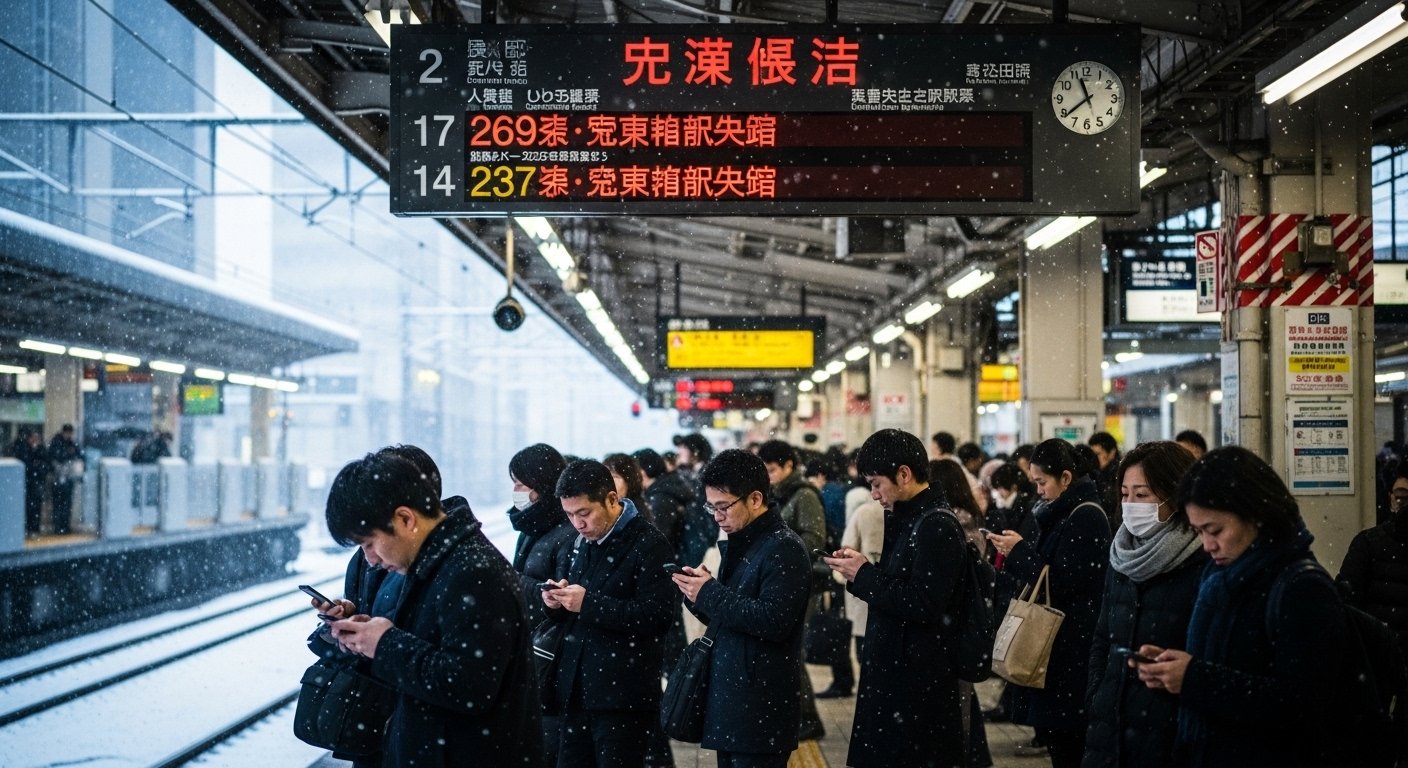
*Images used in this article are for illustration only. They may not be directly related to the content.
Stranded by Snow & Ice in Japan? Your Essential Emergency Guide
Japan’s winters can be breathtaking, transforming landscapes into serene, snowy vistas. However, heavy snowfall and icy conditions can quickly turn picturesque scenes into stressful situations, particularly if you’re an international visitor navigating unfamiliar territory. Imagine your train unexpectedly grinding to a halt, or your bus service cancelled without clear information. The feeling of helplessness, compounded by language barriers, can be daunting.
This comprehensive guide is designed to remove that friction. We’ll equip you with practical tools, essential Japanese phrases, and step-by-step procedures to confidently handle disruptions caused by snow and ice. From communication failure to staying safe in cold weather, consider this your local fixer for any Japan snow emergency.
Table of Contents
- The Challenge: Navigating Winter Disruptions in Japan
- Your Immediate Action Plan When Stranded
- Essential Apps for Your Japan Snow Emergency Toolkit
- Emergency Contacts: When to Call for Help
- 🇯🇵 Point & Speak: Crucial Japanese Phrases for Emergencies
- Pro-Tips for Winter Travel Safety in Japan
- Common Mistakes to Avoid in a Snow Emergency
- 📋 Quick Reference Card: Your Go-To Checklist
- Frequently Asked Questions
The Challenge: Navigating Winter Disruptions in Japan
The beauty of Japan’s winter can mask its potential for significant travel disruption. Heavy snowfall, especially in regions like Hokkaido or along the Sea of Japan coast, can lead to widespread transportation cancellations and delays. For visitors, this presents several distinct challenges:
- Feeling Helpless: Being stuck in an unfamiliar place, unable to reach your destination, can be anxiety-inducing.
- Communication Barriers: Not all staff, especially in rural areas, speak English. Explaining your situation or understanding instructions in Japanese can be difficult.
- Lack of Local Knowledge: You might not know the local emergency procedures, where to find shelter, or how to access real-time information sources.
- Safety Risks: Prolonged exposure to cold, slips on ice, or falls in deep snow can lead to hypothermia, frostbite, or injuries.
Addressing these pain points proactively is key to a safer and smoother winter trip. Preparedness mitigates risk and provides peace of mind.
Your Immediate Action Plan When Stranded
When heavy snow or ice disrupts your travel, quick and systematic action is crucial. Follow these steps to manage the situation effectively:
Step 1: Assess Your Situation & Stay Warm
Your immediate safety is paramount. If your train or bus stops, or you find yourself unexpectedly delayed, prioritize staying warm and safe.
- Stay Put Initially: Unless instructed to evacuate, remain in your vehicle or at the station. It’s often the safest place.
- Protect Against Cold: Ensure you are wearing all available warm layers. This includes hats, gloves, and waterproof outer layers. Hypothermia prevention is critical.
- Seek Shelter: If you are outdoors or in an unheated area, look for immediate warmth. Convenience stores (conbini), station buildings, or local community centers are often open and heated.
Visual cue: Look for large commercial signs for 7-Eleven, Lawson, or FamilyMart (convenience stores). At stations, look for “駅” (Eki) signs.
Step 2: Get Real-Time Information
Accessing accurate, up-to-date information is vital for making decisions.
- Check Official Transport Websites/Apps: Major railway companies (JR East, JR West, Hokkaido Railway Company) and bus operators have websites with delay/cancellation information.
🎯 Local Pro-Tip: Even if you don’t speak Japanese, look for kanji like ‘遅延 (chien)’ for delay, ‘運休 (unkyū)’ for cancellation, or ‘運転見合わせ (unten miawase)’ for suspended service on information screens or websites.
- Use Transit Apps: Apps like NAVITIME Japan Transit Planner or Jorudan often provide real-time updates and alternative routes, sometimes in English.
Visual cue: Green or blue information boards at stations often have scrolling text displaying delay/cancellation notices. These may cycle through English.
- Check Weather Warnings: The Japan Meteorological Agency (JMA) provides English weather warnings, including heavy snow alerts.

Step 3: Seek Local Assistance
When digital information is unclear or insufficient, turn to human resources.
- Approach Station Staff/Bus Drivers: They are your primary point of contact for transportation issues. Even if they don’t speak English, a translation app or prepared phrase (see Point & Speak below) can help.
Visual cue: Look for staff wearing uniforms (typically dark suits or company-specific jackets/hats) at ticket gates or on platforms. Information counters (案内所 – Annaijo) at major stations are also key.
- Use Emergency Call Buttons: On train platforms and inside trains, red emergency call buttons are available. They are often labeled with ‘緊急 (KINKYŪ)’ or a symbol of a person calling for help. Use these if you need immediate assistance due to injury or severe distress.
Visual cue: Bright red buttons, usually prominent, with clear symbols.
- Look for Emergency Shelters (避難所 – Hinanjo): In major weather disruptions, local municipalities open designated shelters. These are safe places to stay, often with basic provisions. Information is typically broadcast locally, and signs will be posted.
Visual cue: Signs with the kanji ‘避難所’ (Hinanjo), often accompanied by a green symbol of a person evacuating.

Essential Apps for Your Japan Snow Emergency Toolkit
Your smartphone is a powerful tool. Prepare it before your trip with these crucial applications:
- Safety tips: Operated by the Japan Tourism Agency, this app provides real-time alerts for various disasters, including heavy snow warnings, in multiple languages. It also lists emergency contacts and a communication card. Download it here. Crucial for proactive awareness.
- Offline Maps (Google Maps, Apple Maps): Download regions you plan to visit for offline use. This ensures you can navigate even without an internet connection, which can happen in remote or disaster-struck areas.
- Translation Apps (Google Translate, DeepL, Papago): Download Japanese for offline use in Google Translate. While DeepL and Papago often require internet, they are excellent for more nuanced translations when connectivity is available. Prepare key phrases in advance.
- Transit Apps (NAVITIME, Jorudan, Yahoo! Japan Transit): As mentioned above, these are indispensable for checking routes, delays, and cancellations.

Emergency Contacts: When to Call for Help
Knowing who to call and when is critical for any Japan snow emergency. Keep these numbers accessible.
🚨 Emergency Contacts
| Police | 110 |
| Ambulance/Fire | 119 |
| JNTO Japan Visitor Hotline (English, Chinese, Korean, Japanese – 24/7) | 050-3816-2787 |
| 171 Emergency Message Dial (Activated during large-scale disasters) | 171 |
All numbers are free and work from any phone in Japan. For 110/119, English operators are not guaranteed, so have phrases ready.
🇯🇵 Point & Speak: Crucial Japanese Phrases for Emergencies
A few key phrases can bridge the communication gap significantly. Practice these or have them ready on your phone to show to staff or emergency personnel.
🇯🇵 Point & Speak
Show this section to staff if you’re stuck. They can read the Japanese.
English: I need help.
助けてください。
(Tasukete kudasai.)
English: I am stranded.
立ち往生しています。
(Tachiōjō shiteimasu.)
English: My train/bus is delayed/cancelled.
電車/バスが遅延/運休しています。
(Densha/Basu ga chien/unkyū shiteimasu.)
English: Is there an emergency shelter?
避難所はありますか?
(Hinanjo wa arimasu ka?)
English: I am cold.
寒いです。
(Samui desu.)
English: I am injured.
怪我をしました。
(Kega o shimashita.)
English: I cannot speak Japanese.
日本語が話せません。
(Nihongo ga hanasemasen.)
English: Do you speak English?
英語を話せますか?
(Eigo o hanasemasu ka?)
English: Where is the nearest station/hospital?
最寄りの駅/病院はどこですか?
(Moyori no eki/byōin wa doko desu ka?)
English: Please wait a moment.
少し待ってください。
(Sukoshi matte kudasai.)
Pro-Tips for Winter Travel Safety in Japan
Beyond the basics, these insider tips can make a significant difference in a snow emergency.
🎯 Local Pro-Tip: Carry a Portable Charger.
Reliable phone battery is your lifeline. Communication, maps, and translation apps are useless if your phone dies. A fully charged power bank is non-negotiable for winter travel.
- Dress for the Cold: Wear multiple layers, including thermal underwear, sweaters, and a waterproof, insulated outer jacket. A hat, gloves, and a scarf are essential. Prioritize waterproof, non-slip footwear.
- Hypothermia & Frostbite Prevention: If you feel extreme cold, uncontrollable shivering, or numbness in extremities, seek warm shelter immediately. Recognize these symptoms in yourself and others.
- Keep Physical Documents: While apps are great, have physical copies or photos of your passport, visa, accommodation bookings, and important contact numbers. In case of battery failure or signal loss, these are invaluable.
- Inform Someone of Your Plans: Share your itinerary with family or friends back home. Check in regularly, especially if traveling to remote areas prone to heavy snow.
- Check Weather Forecasts Daily: Use reliable sources like the JMA website. Be aware of potential heavy snow warnings well in advance.
- Budget for Contingencies: Being stranded can lead to unexpected expenses for extra accommodation, food, or alternative transport. Ensure you have sufficient funds or travel insurance coverage for such eventualities.
- Know Your Embassy/Consulate: Keep their contact information handy for prolonged disruptions or serious emergencies.
Common Mistakes to Avoid in a Snow Emergency
Preventative measures are often about avoiding common pitfalls:
- Underestimating Japanese Winter: Even cities can experience significant snowfall. Don’t assume mild conditions.
- Relying Solely on English: While major tourist hubs have English support, don’t expect it universally, especially during emergencies.
- Ignoring Warnings: Japanese warnings are often very precise. Take snow and ice advisories seriously.
- Panicking and Acting Impulsively: Take a moment to assess, use your resources (apps, phrases, contacts), and follow official guidance.
- Dressing Inappropriately: Cotton gets wet and stays wet, losing insulating properties. Opt for wool or synthetics and always have waterproof outer layers.
- Not Charging Devices: Your phone is your lifeline. Keep it charged and carry a portable charger.
📋 Quick Reference Card: Your Go-To Checklist
Screenshot or print this section for easy access – a concise reminder of key actions.
📋 Quick Reference Card
Screenshot or print this section for easy access:
- ✅ Stay Warm: Layer clothing, seek heated shelter.
- ✅ Check Info: Use transit apps, official websites (look for 遅延/運休).
- ✅ Talk to Staff: Show Point & Speak phrases, use translation apps.
- ✅ Key Apps: Safety tips, Offline Maps, Offline Translate (downloaded).
- ✅ Emergency Hotlines: JNTO (050-3816-2787), Police (110), Ambulance/Fire (119).
- ✅ Battery Power: Keep phone charged, carry portable charger.
- ✅ Know Hinanjo: Look for 避難所 (emergency shelter) signs.
Frequently Asked Questions
What is the “Safety tips” app and why is it important for winter travel?
The “Safety tips” app, from the Japan Tourism Agency, provides real-time warnings for various natural disasters, including heavy snow. It delivers push notifications in multiple languages, offering crucial, proactive alerts that can help you adjust plans before you get stranded. It also includes emergency contact information and a communication card.
What should I do if I fall and injure myself on ice?
If you fall and suspect an injury, try to remain calm. Call 119 for an ambulance (or have someone call for you). If you can move safely, try to get to a heated area. Use phrases like “Kega o shimashita” (I am injured) and “Tasukete kudasai” (I need help) with anyone nearby. The JNTO hotline (050-3816-2787) can also offer assistance in finding medical help.
Are emergency shelters in Japan equipped for international visitors?
Emergency shelters (避難所 – Hinanjo) are operated by local municipalities primarily for residents, but they will accommodate anyone in need during a disaster. While specific multilingual support isn’t guaranteed at every location, you will be safe and receive basic provisions. Use your translation apps and pre-learned phrases for communication. The “Safety tips” app lists shelter locations.
What if my SIM card or portable Wi-Fi doesn’t work in a remote snowy area?
This is why offline preparation is critical. Ensure you’ve downloaded maps for your planned regions and the Japanese language pack for your translation app (e.g., Google Translate) before heading into remote areas. Having physical notes of key contacts and destinations also serves as a backup. In severe outages, public phones or local assistance points might be your only connection.
Conclusion
Winter travel in Japan offers unforgettable experiences, but preparedness is the best way to ensure safety and minimize stress when faced with unforeseen disruptions. By equipping yourself with essential apps, key phrases, and knowledge of local procedures, you can navigate a Japan snow emergency with confidence and ensure your trip remains memorable for the right reasons.
Stay warm, stay informed, and enjoy the unparalleled beauty of Japan, come snow or shine.
Disclaimer
This guide provides general information and practical advice for visitors to Japan dealing with snow and ice-related emergencies. While every effort has been made to ensure accuracy as of January 2026, emergency situations are dynamic. Always prioritize official instructions from local authorities, transportation companies, and emergency services. This information should not replace professional advice or official emergency protocols.