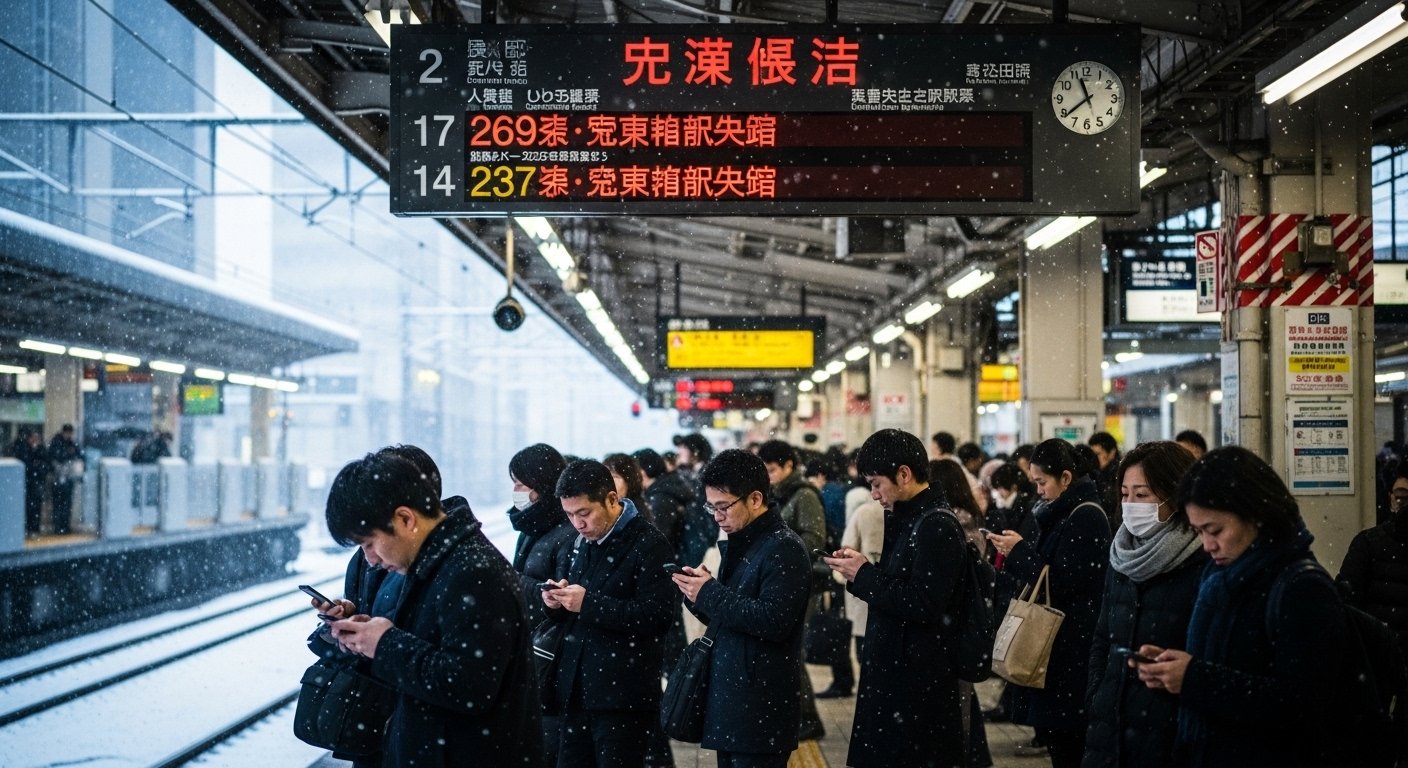
*Images used in this article are for illustration only. They may not be directly related to the content.
Surviving Unexpected Winter Train & Bus Delays in Japan: Real-Time Info & Backup Plans
Unexpected transport delays can disrupt any travel plan, but in Japan’s winter, they carry unique challenges. Heavy snow, ice, and strong winds frequently impact train and bus services, especially in northern regions like Hokkaido and Tohoku, along the Sea of Japan coast, and even the Tokaido Shinkansen route. As an international visitor, not understanding Japanese announcements or knowing where to find alternative solutions can quickly lead to frustration and feeling stranded.
This comprehensive guide equips you with practical, real-time information and concrete backup plans. We will help you overcome language barriers, find reliable transport alternatives, and minimize disruption to your itinerary. Prepare effectively to navigate Japan’s winter transport network with confidence.
Table of Contents
- The Challenge: Winter Delays and Language Barriers
- Your First Steps: Real-Time Information at Your Fingertips
- Navigating the Disruption: Backup Plans & Practical Actions
- 🇯🇵 Point & Speak: Essential Phrases for Delays
- 🚨 Emergency Contacts (Beyond Transport)
- Common Mistakes to Avoid During Delays
- Frequently Asked Questions
The Challenge: Winter Delays and Language Barriers
Japan’s public transport is renowned for its punctuality, yet winter weather conditions are a significant exception. From December to March, heavy snowfall (大雪 – Ooyuki) and strong winds (強風 – Kyōfū) can halt train and bus operations. This is particularly true in Hokkaido, Tohoku, and the Hokuriku regions. Even major routes, including parts of the Tokaido Shinkansen, can experience substantial delays or cancellations due to snow buildup or ice.
The primary pain point for many international visitors is the language barrier. Official delay announcements are predominantly in Japanese, often delivered rapidly over public address systems or displayed on station boards without extensive English translation. This makes it difficult to understand the cause, expected duration, or recommended alternative routes for any Japan winter train delay.
Getting stranded due to a Japan bus cancellation snow or unexpected train halt can impact your entire itinerary. Missing a connection, losing pre-booked accommodation, or facing unexpected costs for alternative transport are real possibilities. While major stations have some English-speaking staff, during widespread disruptions, these points become overwhelmed, and local lines or buses may have no English support at all.
Your First Steps: Real-Time Information at Your Fingertips
When a delay or cancellation strikes, your immediate priority is accurate, real-time information. Here’s how to access it:
1. At the Station: Visual Cues & Display Boards
Observe the station environment. Digital display boards are your first visual cue. Look for your train number and destination, then check the status column. Key Japanese terms to recognize:
- 遅延 (Chien): Delay
- 運休 (Unkyū): Cancellation
- 運転見合わせ (Unten Miawase): Operations Suspended
- 運転再開 (Unten Saikai): Service Resumed
These terms are often color-coded, with red or orange indicating disruptions. Paper notices (often titled お詫び – Owabi, meaning “Apology”) are also posted near ticket gates or information boards. While mostly in Japanese, they detail reasons for delays and expected recovery times, with numbers (times) being universally understandable.

2. Essential Apps & Websites
Your smartphone is your most powerful tool during a Japan transport disruption. Ensure you have reliable mobile data or a pocket Wi-Fi device. These apps and websites offer real-time updates and alternative route suggestions:
- Google Maps: Provides real-time transit updates and often suggests alternative routes, including buses and walking.
- Japan Transit Planner (Jorudan / NAVITIME): Dedicated transit apps providing detailed route information, including delay status. These are highly accurate.
- Yahoo! Transit (Yahoo! 乗換案内 – Yahoo! Norikae Annai): A popular Japanese app. While primarily in Japanese, its interface is intuitive, and delay statuses are often clearly marked.
- Official Railway Company Websites: These are the most authoritative sources for specific line information.
- JR East Operation Information (English)
- JR West Operation Information (English)
- JR Central Tokaido Shinkansen Operation Information (Japanese) – Google Translate can help here.
- Japan Meteorological Agency (JMA): Check for weather warnings that might indicate ongoing or impending disruptions.
🎯 Local Pro-Tip: Before your trip, download offline maps of your destinations using Google Maps. Also, consider downloading the Japan Transit Planner app and familiarizing yourself with its interface. A fully charged power bank is essential for keeping your devices alive.
Navigating the Disruption: Backup Plans & Practical Actions
1. Seeking Staff Assistance
Major train stations have designated information counters (案内所 – Annaijo) or ‘Midori no Madoguchi’ (みどりの窓口 – JR Ticket Office) where staff can provide assistance. During peak disruption, these areas will be overwhelmed. Approach staff calmly, and be prepared to wait. English proficiency varies, especially outside major tourist hubs, but they will often try to assist.
If you have an urgent question but struggle with Japanese, prepare one of the “Point & Speak” phrases below or use a translation app. Show them your ticket or destination on a map to clarify your needs.
2. Exploring Alternative Transport Options
If your primary route is suspended, consider these alternatives:
- Other Train Lines: In major cities, an extensive network means you might be able to find another railway company’s line serving a similar direction. Use your transit apps for suggestions.
- Local Buses: Buses can be a viable alternative for shorter distances or if train lines are completely shut down. However, buses are also susceptible to snow and ice conditions, potentially operating on delayed schedules or suspended routes themselves. During heavy snow, they may be the only option for local travel.
- Taxis: Taxis are an option, but come with caveats. During major disruptions, they become scarce and expensive, particularly in rural areas where surge pricing may apply. You could face long waits and significantly higher fares, especially if your destination is far. Always have some cash (¥5,000-¥10,000) for taxi fares, as credit card machines may not always work, or drivers may prefer cash. Look for ‘タクシー乗り場’ (Taxi Noriba) signs, usually outside major station exits.
Remember regional disparity: Major cities offer more alternative transport options. Rural areas are far more vulnerable to complete isolation during heavy snow or high winds, with very limited alternatives and slower recovery.
3. Refunds (払い戻し) & Delay Certificates (遅延証明書)
In case of a major delay (typically 2 hours or more) or cancellation, you may be eligible for a refund (払い戻し – Haraimodoshi) for your ticket. Head to a ticket counter (切符売り場 – Kippu Uriba) or a Midori no Madoguchi. Keep your original ticket.
For proof of delay – for travel insurance claims, employer records, or missed connections – you can obtain a Delay Certificate (遅延証明書 – Chien Shōmeisho). These are available from station staff or can often be printed at designated machines or even online via the railway company’s website (usually in Japanese only). These typically cover delays from 5 minutes up to an hour or more, depending on the railway company. Keep it for your records.
Remember that unforeseen delays can lead to unexpected taxi fares or last-minute accommodation costs. Travel insurance with delay/cancellation coverage is crucial. This is a critical aspect of your overall Japan travel insurance planning.
4. Accommodation if Stranded Overnight
If you are stranded and facing an overnight stay, your options might be limited, especially in smaller towns. Start searching for nearby hotels immediately using online booking sites like Booking.com, Agoda, Rakuten Travel, or Jalan.net. Expect high demand and limited availability. Some major stations may offer limited shelter, but this is not guaranteed.

🇯🇵 Point & Speak: Essential Phrases for Delays
🇯🇵 Point & Speak
Show this section to staff if you’re stuck. They can read the Japanese.
English: Is the train delayed?
電車は遅れていますか?
(Densha wa okurete imasu ka?)
English: How long is the delay?
どのくらい遅れますか?
(Dono kurai okuremasu ka?)
English: What is the alternative route?
代替ルートはありますか?
(Daitai rūto wa arimasu ka?)
English: Where can I get a delay certificate?
遅延証明書はどこでもらえますか?
(Chien shōmeisho wa doko de moraemasu ka?)
English: I want a refund.
払い戻しをお願いします。
(Haraimodoshi o onegaishimasu.)
English: Operations suspended.
運転見合わせ
(Unten miawase)
English: Heavy snow.
大雪
(Ooyuki)
🚨 Emergency Contacts (Beyond Transport)
🚨 Emergency Contacts
| Police | 110 |
| Ambulance/Fire | 119 |
All numbers are free and work from any phone, even without credit or an active plan in most cases. For non-emergencies or general inquiries, consider the Japan Visitor Hotline: 050-3816-2787 (English available).
While these are not directly for transport delays, they are essential to have in a true emergency, especially if you are feeling unwell or require medical attention while stranded.
Common Mistakes to Avoid During Delays
Being prepared isn’t just about knowing what to do, but also what not to do:
- Panicking or Rushing: Japan’s transport system, even delayed, prioritizes safety. Rushing or trying to force your way onto overcrowded trains can be dangerous and counterproductive. Remain calm and follow staff instructions.
- Assuming a Quick Recovery: Winter delays, especially due to heavy snowfall or strong winds, can be prolonged. Do not assume service will resume shortly. Always have a backup plan for potentially lengthy waits or an overnight stay.
- Relying Solely on One App/Information Source: Cross-reference information from multiple sources (station boards, official railway websites, transit planner apps) to get the most accurate picture.
- Ignoring Local Weather Warnings: Always check the Japan Meteorological Agency (JMA) website for local weather warnings before you travel, especially if heading to mountainous or coastal regions. This can help you anticipate potential disruptions.
- Not Dressing Appropriately: If you’re stranded on a platform or in an unheated area, proper winter clothing is critical. Layers, a warm coat, hat, gloves, and waterproof footwear are essential.
- Forgetting Snacks and Water: Keep some non-perishable snacks and water in your day pack. Shops at stations might be closed or sold out during extended delays.
- Assuming JR Pass Covers Everything: While the JR Pass is excellent, it does not cover alternative transport (like private railway lines or taxis) if JR lines are disrupted. Understand its limitations during service interruptions.
🎯 Local Pro-Tip: Always have a small emergency kit in your backpack: a portable charger, some cash, a few snacks, a warm scarf, and a copy of important phone numbers (hotel, embassy) written down, not just on your phone.
Frequently Asked Questions
Can my JR Pass cover alternative transport if JR lines are delayed or cancelled?
Generally, no. Your JR Pass is valid only for JR lines. If JR services are disrupted, you may need to purchase separate tickets for alternative private railway lines, buses, or pay for a taxi. In some rare cases of severe, prolonged disruption, JR might arrange substitute bus services, which would typically be covered, but this is not common for typical winter delays.
What if I miss my flight or hotel check-in due to a train delay?
If you miss a flight, contact your airline as soon as possible. Some airlines offer flexibility for flight changes due to transport disruptions, but this is not guaranteed. For hotels, contact them directly to inform them of your delay and expected arrival time. Many hotels are understanding if you communicate proactively. This is where comprehensive travel insurance for Japan with delay/cancellation coverage can be invaluable, helping to recoup lost costs or cover rebooking fees.
Are winter train delays in Japan predictable?
While specific incidents are not predictable, the likelihood of delays due to winter weather (heavy snow, high winds, freezing rain) is high in certain regions and months (December-March). Monitoring weather forecasts, especially those from the Japan Meteorological Agency, can help you anticipate general conditions. Adjusting your itinerary to include buffer time or choosing routes less affected by extreme weather can mitigate risks.
What should I keep in my bag for potential winter transport delays?
Essential items include a fully charged power bank, a portable Wi-Fi device or reliable data plan, some cash (¥5,000-¥10,000), non-perishable snacks, a reusable water bottle, your passport and relevant booking printouts, warm layers (scarf, hat, gloves), and any necessary medications. Downloading offline maps and translation apps is also highly recommended.
Conclusion
Japan’s winter transport network is efficient, but not immune to nature’s disruptions. By understanding the challenges, preparing with real-time information tools, and having practical backup plans, you can navigate unexpected train and bus delays with confidence. Stay informed, remain calm, and utilize the resources at hand.
With this guide, you are better equipped to minimize friction and ensure a safer, smoother winter journey in Japan.
Disclaimer
This information is provided for general guidance only and is subject to change. Specific details regarding refunds, alternative transport, and operational status are at the discretion of individual transport companies. Always refer to official sources for the most current and accurate information. Travel insurance is highly recommended for all international visitors.