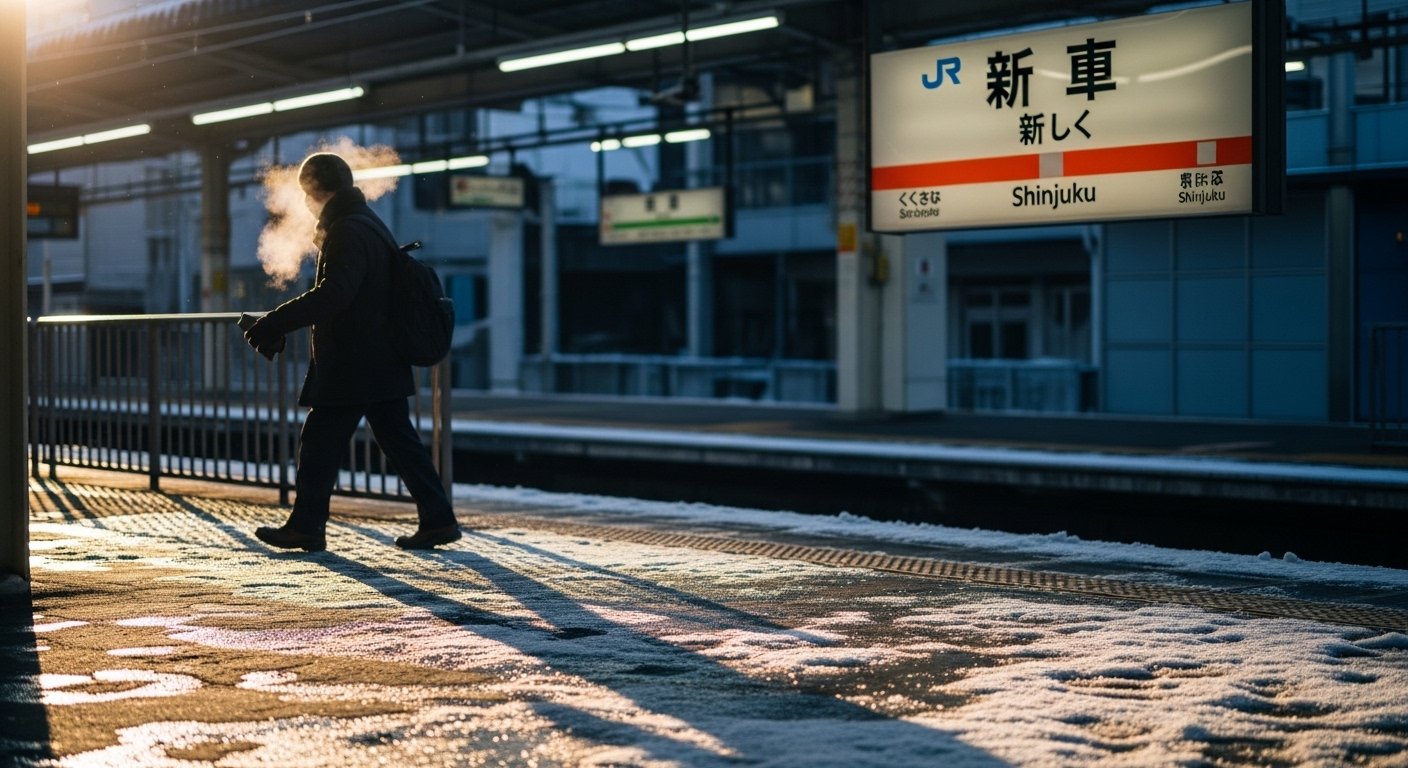
*Images used in this article are for illustration only. They may not be directly related to the content.
Navigating Early Morning Winter Transport Delays in Japan: Your Safety & Backup Plan Guide
Planning an early morning connection in Japan, especially during winter, comes with a unique set of challenges. The thought of missing a crucial flight or Shinkansen due to unexpected snow or strong winds can be a source of significant stress. You’re not alone in feeling this way. For international visitors, language barriers, unfamiliar systems, and the cold can amplify the feeling of being stranded when Japan winter transport delays hit. This guide is designed to remove that friction, providing you with practical tools, real-time strategies, and backup plans to navigate potential disruptions safely and confidently.
We’ll cover everything from understanding real-time delay information in English to rebooking options, essential Japanese phrases, and critical safety measures. By the end, you’ll be equipped to handle unexpected early morning travel disruptions, ensuring your journey through Japan remains smooth, even in challenging winter conditions.
Table of Contents
- The Winter Challenge: Why Japan’s Early Morning Transport is Vulnerable
- Stay Informed: Real-Time Updates & Essential Apps
- Immediate Actions When Facing Delays or Cancellations
- 🇯🇵 Point & Speak: Essential Phrases for Staff
- Rebooking & Refunds: Your Rights and Options
- Backup Plans: Alternative Routes & Contingencies
- 💰 Price Breakdown: Understanding Taxi Costs
- 📋 Quick Reference Card: Your On-the-Go Checklist
- 🎯 Local Pro-Tips for Winter Travel
- Staying Safe and Comfortable During Delays
- 🚨 Emergency Contacts
- Frequently Asked Questions
- Conclusion: Travel Smart, Stay Safe
- Disclaimer
The Winter Challenge: Why Japan’s Early Morning Transport is Vulnerable
Japan’s public transport system is renowned for its punctuality, but even the most efficient networks face challenges. Winter weather, particularly heavy snowfall (大雪 – Ōyuki) and strong winds (強風 – Kyōfū), frequently causes significant disruptions. Regions like Hokkaido, Tohoku, and the Japan Sea coast (e.g., Hokuriku, San’in) are especially susceptible to these conditions. These aren’t just minor delays; they can lead to full cancellations, impacting Shinkansen, local trains, buses, and even flights. Early morning departures are particularly vulnerable as weather conditions can worsen overnight, leaving little time for service adjustments before the first trains begin running.
For international visitors, this problem is compounded by a few key factors:
- Language Barrier: Station announcements and digital displays are primarily in Japanese, making it difficult to understand real-time updates.
- Unfamiliarity: Not knowing local alternatives or rebooking procedures can lead to feeling stranded.
- Critical Connections: Early morning travel often involves connections to international flights or other long-distance journeys, where delays have cascading effects.
Understanding these challenges is the first step toward effective preparation.
Stay Informed: Real-Time Updates & Essential Apps
Your smartphone is your most valuable tool for navigating disruptions. Reliable internet access (via a Japanese SIM card, eSIM, or pocket Wi-Fi) is non-negotiable.
Step 1: Monitor Weather Forecasts
Before and during your winter trip, pay close attention to weather warnings. This is especially crucial for early morning travel. The Japan Meteorological Agency (JMA) is the official source.
- Japan Meteorological Agency (JMA) Weather Warnings: Check for snow, strong winds, and heavy rain advisories for your route.
Step 2: Use Real-Time Transit Apps
These apps provide live delay information, alternative routes, and estimated arrival times in English.
- Google Maps: Excellent for real-time transit updates and finding alternative routes, including local buses and private train lines.
- NAVITIME Transit Planner (English): Highly detailed, often preferred by locals for its accuracy and comprehensive routing.
- Jorudan Transit Planner (English): Another reliable option, similar to NAVITIME, for route planning and real-time data.
Step 3: Check Official JR Websites
For Shinkansen and JR lines, the official JR company websites provide the most accurate, up-to-the-minute delay and cancellation information.
- JR East Train Operation Information (English): Covers Tokyo, Tohoku, Nagano, etc.
- JR Central Train Operation Information (English): For Tokaido Shinkansen (Tokyo-Nagoya-Kyoto-Osaka).
- JR West Train Operation Information (English): Covers Kyoto, Osaka, Kobe, Hiroshima, etc.

Immediate Actions When Facing Delays or Cancellations
Understanding the situation quickly is key to minimizing disruption and ensuring your safety.
1. Read the Visual Cues
At the station, look for:
- Digital Display Boards (電光掲示板 – denko keijiban): These show delay information. Look for a prominent red ‘遅延’ (chien – delay) or ‘運休’ (unkyu – cancelled) indicator. Sometimes, English translations scroll below the Japanese.
- Station Announcements: These are typically preceded by a distinctive chime. Listen for keywords like ‘遅延’ (chien – delay), ‘運休’ (unkyu – cancelled), or ‘運行見合わせ’ (unko miawase – service suspended).
- Ticket Gates: During major disruptions, gates might have red ‘X’s or ‘閉鎖中’ (heisa-chū – closed) signs.
- Staff: Look for staff in distinct uniforms (JR: dark blue/black; private railways/subways vary) near ticket gates or information counters. They might have ‘Information’ signs (案内所 – annaijo) or wear English badges.

2. Consult Your Apps
Even if you’re physically at the station, cross-reference with your transit apps. They often process information faster than human announcements, especially for alternative routes.
3. Approach Staff (Use Point & Speak)
If you’re still uncertain, locate station staff. Many major stations (Tokyo, Osaka, Kyoto, Sapporo) and airports have English-speaking personnel or information counters. Look for the ‘i’ (information) symbol or ‘案内所’ (annaijo) sign. Be polite and patient.
🇯🇵 Point & Speak: Essential Phrases for Staff
🇯🇵 Point & Speak
Show this section to staff if you’re stuck. They can read the Japanese. Speak slowly and clearly if attempting English.
English: Is this train delayed?
この電車は遅れていますか?
(Kono densha wa okurete imasu ka?)
English: Is it cancelled?
運休ですか?
(Unkyū desu ka?)
English: What time is the next train?
次の電車は何時ですか?
(Tsugi no densha wa nanji desu ka?)
English: I want to change my reservation.
予約を変更したいです。
(Yoyaku o henkō shitai desu.)
English: I want a refund.
払い戻しをお願いします。
(Haraimodoshi o onegai shimasu.)
English: Is there an alternative route?
代替ルートはありますか?
(Daitai rūto wa arimasu ka?)
English: Do you have an English speaker?
英語を話せる人はいますか?
(Eigo o hanaseru hito wa imasu ka?)
Rebooking & Refunds: Your Rights and Options
Understanding your options for rebooking or obtaining a refund is crucial for managing unexpected costs and continuing your journey.
JR (Japan Railways) Policy
If a JR train (including Shinkansen) is canceled or delayed by more than 2 hours, you are typically entitled to a full refund for the unused portion of your ticket. This applies to both reserved and non-reserved seats.
- For Non-Reserved Seats: Refunds are often processed immediately at any ticket counter (みどりの窓口 – Midori no Madoguchi) or even at the ticket gate with staff assistance.
- For Reserved Seats (Shinkansen, Limited Express): You may be offered to transfer your reservation to the next available train without charge. If you choose not to travel or no suitable alternative is available, a full refund can be processed at a ticket counter. Keep your physical ticket; do not pass through the ticket gate if you intend to get a refund without travel.
- JR Pass Holders: While you won’t get a cash refund for a specific journey, if a Shinkansen or Limited Express train is canceled, you can usually take the next available train without needing a new reservation, or use local JR lines.
🎯 Local Pro-Tip: Always keep your ticket until you’ve completed your journey or successfully obtained a refund. Lost tickets cannot be refunded. If you have a physical ticket, present it at a JR ticket office.
Airline Policy for Flight Delays/Cancellations
If your flight is delayed or cancelled due to weather, airlines typically rebook passengers on the next available flight at no additional charge. However, if your flight delay is a direct consequence of a train delay (i.e., you missed your flight because your train was late), the airline is generally not responsible for compensation or rebooking unless your train and flight were purchased together as a single package (e.g., a flight + rail package from a travel agent). In such cases, contact your travel provider directly.
Backup Plans: Alternative Routes & Contingencies
Having a Plan B is essential, especially for critical early morning connections.
1. Explore Alternative Train Lines
Japan’s train lines are highly interconnected. If a specific JR line is down in a major city, alternative private railway lines or subway lines might cover similar routes. Your transit apps (Google Maps, NAVITIME, Jorudan) are excellent for identifying these alternatives. Be prepared to pay separately for these private lines as they are not covered by JR Passes.

2. Consider Taxis (with caution)
Taxis can be a last resort for shorter distances or when no other public transport is available. Taxi stands (タクシー乗り場 – takushī noriba) are usually clearly marked outside stations, often with queues. However, be aware of the costs.
💰 Price Breakdown: Understanding Taxi Costs
💰 Price Breakdown: Estimated Taxi Costs
| Item | Cost |
| Initial fare (first ~1-2km) | ¥420-750 |
| Per additional ~200-300m | ¥80-100 |
| Typical 30-minute ride (5-10km) | ¥3,000-¥6,000 |
| Early morning surcharge (22:00/23:00 – 05:00) | 20-30% extra |
Prices verified as of January 2026. Fares can vary by region and taxi company.
3. Accommodation Near Transport Hubs
For crucial early morning flights or Shinkansen connections, consider booking a hotel near the airport or major train station the night before. This provides a significant buffer against unexpected delays and ensures you are well-rested.
4. Luggage Forwarding Services
If you’re facing a major disruption and need to change your plans dramatically, consider utilizing Japan’s efficient luggage forwarding services (e.g., Yamato Transport “Takkyubin”). This allows you to travel light while your luggage is sent directly to your next accommodation or airport, reducing stress if you need to take alternative, potentially crowded, transport. Learn more about luggage forwarding in Japan.
📋 Quick Reference Card: Your On-the-Go Checklist
📋 Quick Reference Card
Screenshot or print this section for easy access:
- ✅ Internet Access: Ensure your phone has data (SIM/eSIM/Wi-Fi).
- ✅ Key Apps: Google Maps, NAVITIME, Jorudan installed.
- ✅ Official JR Links: Bookmarked for quick access.
- ✅ Local Weather: Check JMA before early departures.
- ✅ Keep Tickets: Retain all physical tickets for refunds.
- ✅ Approach Staff: Look for ‘i’ signs or English badges.
- ✅ Emergency Numbers: 110 (Police), 119 (Ambulance/Fire).
- ✅ Buffer Time: Always build extra time into your itinerary.
- ✅ Warmth/Snacks: Carry essentials, use convenience stores.
🎯 Local Pro-Tips for Winter Travel
🎯 Local Pro-Tip: Prioritize Buffer Time: For any crucial early morning connection (especially flights), plan to arrive at your departure city or even the airport/station area the evening before. An extra night’s stay can save significant stress and cost. Even a few extra hours built into your schedule can be a game-changer.
🎯 Local Pro-Tip: Travel Insurance is Your Friend: Invest in comprehensive travel insurance that covers trip interruptions, delays, and cancellations due to weather. While Japanese transport companies have their own refund policies, insurance can cover non-refundable pre-booked activities, unexpected accommodation, or rebooking costs not covered by airlines.
🎯 Local Pro-Tip: Charge Your Devices: Always keep your phone, portable charger, and any other communication devices fully charged. You’ll rely heavily on them for information and navigation.
Staying Safe and Comfortable During Delays
Unexpected delays can be lengthy, especially in cold winter conditions. Prioritizing your safety and comfort is paramount.
1. Stay Warm
Japan’s winter can be unforgiving. Dress in layers, including thermal underwear, a warm jacket, hat, gloves, and waterproof footwear. If stranded, seek indoor areas within the station or nearby buildings.

2. Hydration and Snacks
Carry a water bottle and some non-perishable snacks. While major stations have vending machines and shops, during severe disruptions, options might be limited or crowded. Convenience stores (コンビニ – konbini) are ubiquitous and provide warmth, hot drinks, food, and basic necessities.

3. Seek Assistance for Vulnerable Individuals
If you are traveling with children, elderly individuals, or have specific medical needs, make this clear to station staff. In cases of severe, prolonged delays or cancellations, major stations might offer temporary warming spaces or distribute emergency supplies (e.g., blankets, water), though this is more common during large-scale disasters than typical winter delays.
🚨 Emergency Contacts
While transport delays are not typically an emergency, knowing these numbers can be crucial if a situation escalates.
🚨 Emergency Contacts
| Police | 110 |
| Ambulance/Fire | 119 |
All numbers are free and work from any phone (including foreign cell phones) within Japan. No need for an area code.
Frequently Asked Questions
What are the most common causes of Japan winter transport delays?
The primary causes are heavy snowfall (大雪), which can accumulate on tracks and roads, and strong winds (強風), particularly along coastal areas and mountainous regions, affecting both trains (especially Shinkansen) and flights. Ice accumulation can also play a role.
Will my travel insurance cover costs from a Shinkansen cancellation due to snow?
Most comprehensive travel insurance policies do offer coverage for trip delays, interruptions, and cancellations caused by severe weather. However, policy specifics vary. It is crucial to review your policy documents or contact your insurance provider directly before your trip to understand what is covered, including limits for accommodation, rebooking, and meals.
How can I find alternative transport if my train is cancelled and I don’t speak Japanese?
Your best tools are real-time navigation apps like Google Maps, NAVITIME, or Jorudan, which have English interfaces and can suggest alternative routes using different train lines or buses. Additionally, locate station staff (look for ‘案内所’ or an ‘i’ symbol) and use the “Point & Speak” phrases provided in this guide, or a translation app, to communicate your situation. Many major stations have English-speaking staff.
Are there warming shelters at train stations during severe winter delays?
While not standard for typical delays, in cases of severe, widespread disruptions or extreme weather, major stations may designate temporary warming areas or distribute basic emergency supplies (like blankets or water) for stranded passengers. For less severe situations, convenience stores (konbini) near stations provide warmth, food, and drinks.
What should I do if my flight is missed due to a Japan train delay?
Immediately contact your airline or travel agent. If you purchased the train and flight as a single package, your provider might rebook you. If purchased separately, the airline is generally not responsible for missed connections due to external factors like train delays. In such cases, your travel insurance may be your best recourse for rebooking fees or other unexpected costs.
Conclusion: Travel Smart, Stay Safe
Winter travel in Japan offers unique beauty, but requires preparation. While Japan’s transport system is world-class, early morning winter weather can bring unforeseen challenges. By staying informed with real-time apps, understanding your options for rebooking and refunds, having backup plans, and knowing key Japanese phrases, you can significantly reduce stress and enhance your safety.
Embrace the adventure, but equip yourself with the tools to navigate any unexpected turns. Your memorable Japanese journey should be defined by discovery, not disruption.
Disclaimer
This guide provides general information and practical advice based on common practices in Japan as of January 2026. Policies of transport companies, airlines, and insurance providers can change. Always verify the most current information with official sources. This information is not legal advice and should not be relied upon as such. While we strive for accuracy, individual situations may vary, and we cannot be held responsible for outcomes based on this guide.