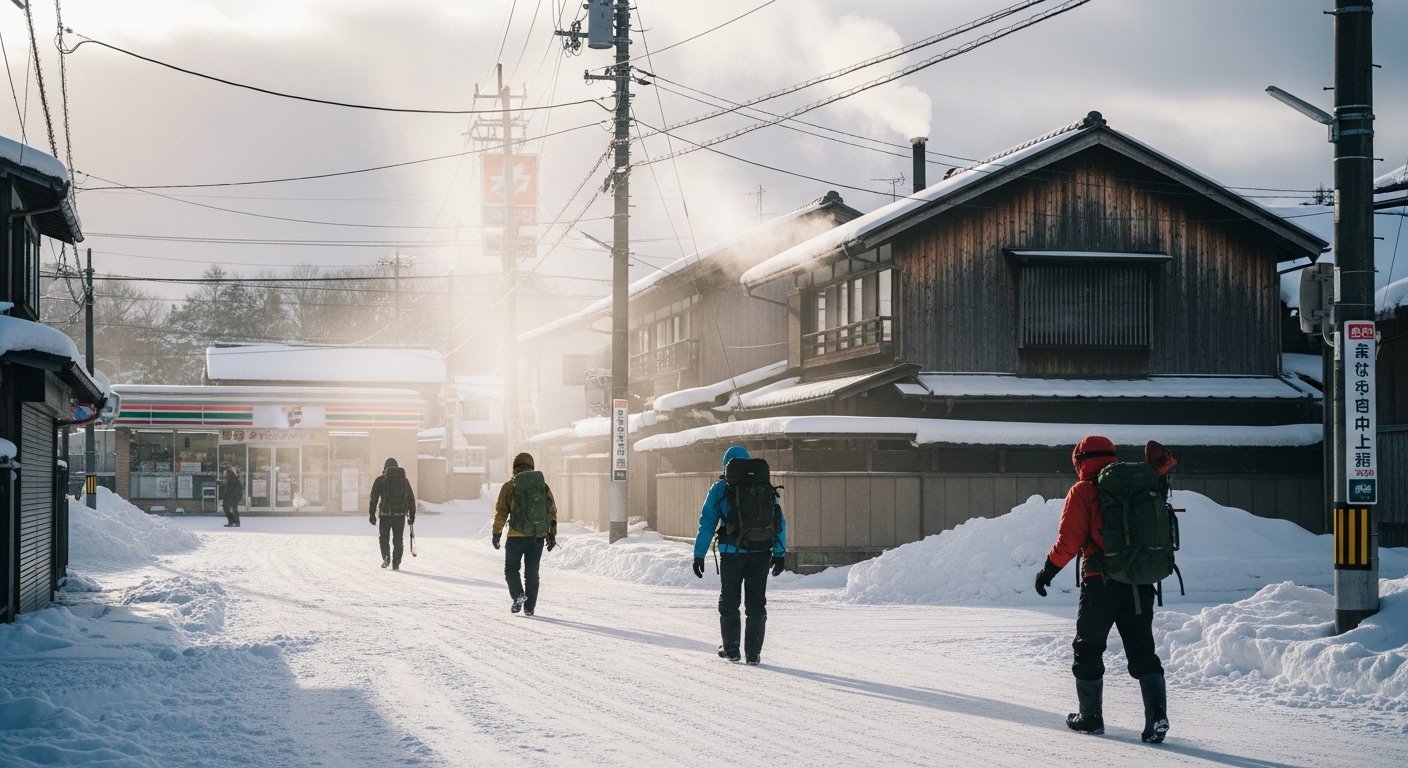
*Images used in this article are for illustration only. They may not be directly related to the content.
Beat Japan’s Year-End Travel Rush: Navigate Crowded Trains & Airports Safely
Planning to experience Japan during the year-end holidays, a period locally known as Nenmatsu Nenshi (年末年始)? You’re in for a unique cultural experience, but you’re also stepping into one of the busiest travel periods of the year. The thought of navigating Japan’s typically efficient yet overwhelmingly crowded trains and airports can be daunting, especially with luggage in tow and the pressure of peak season.
This comprehensive guide is designed to remove that friction. We’ll equip you with practical strategies and local insights to safely and efficiently manage Japan’s year-end travel rush, minimize stress, avoid lost belongings, and ensure your journey is as smooth as possible.
Table of Contents
- Understanding the Year-End Travel Rush in Japan
- Pre-Travel Essentials: Booking & Preparation
- Mastering Luggage Logistics: Travel Light, Travel Smart
- Navigating Crowded Stations & Airports
- Personal Safety & Security in Crowds
- 🇯🇵 Point & Speak: Essential Japanese Phrases
- Alternative Transportation Strategies
- Common Mistakes to Avoid
- 🎯 Local Pro-Tips
- 🚨 Emergency Contacts
- 📋 Quick Reference Card
- Frequently Asked Questions
- Conclusion
- Disclaimer
Understanding the Year-End Travel Rush in Japan
Japan’s year-end travel rush, known as Nenmatsu Nenshi (年末年始), is a significant holiday period when many Japanese return to their hometowns or travel for traditional New Year celebrations. This surge in domestic travel creates intense congestion across all public transport networks.
When to Expect the Crowds
The peak travel window typically runs from approximately December 28th to January 5th. Be prepared for the highest concentration of travelers on:
- Departures from major cities: December 29th-31st.
- Returns to major cities: January 2nd-4th.
During these days, trains, especially Shinkansen, and airports operate at maximum capacity. Expect platforms, concourses, and baggage claim areas to be exceptionally busy.
Pre-Travel Essentials: Booking & Preparation
Book Shinkansen Tickets Months in Advance
For high-speed rail, securing your Shinkansen tickets early is not just recommended; it’s essential. Reserved-seat Shinkansen tickets for the year-end period often sell out months ahead of time. Japan Rail (JR) typically releases tickets one month prior to travel, but for peak times like Nenmatsu Nenshi, they can be snatched up almost immediately.
- Action: Book your tickets as soon as your travel dates are firm. Utilize online services like SmartEX for Tokaido, Sanyo, and Kyushu Shinkansen lines.
- Warning: Unreserved cars will be extremely crowded, often standing room only for the entire journey. Do not rely on unreserved seating during this period, especially with heavy luggage.
🎯 Local Pro-Tip: If you plan to use a Japan Rail Pass, you still need to make seat reservations. Do this immediately upon exchanging your pass at a JR Ticket Office (Midori no Madoguchi). Even with a pass, reserved seats can sell out.
Domestic Flights as an Alternative
For longer distances, domestic flights can be an alternative to Shinkansen. However, like train tickets, these also need to be booked well in advance to secure reasonable prices and availability during the year-end rush.
Mastering Luggage Logistics: Travel Light, Travel Smart
Managing heavy or oversized luggage is one of the biggest challenges during the year-end travel rush. Japan’s stations, while well-equipped, become a labyrinth when packed with people. Minimize your burden to reduce stress and navigate efficiently.

Baggage Delivery Services (Takkyubin)
This is your best friend for stress-free travel. Services like Yamato Transport’s ‘Takkyubin’ and Sagawa Express allow you to send luggage from airports, hotels, and convenience stores directly to your next destination. This frees you from dragging bags through crowded stations and onto packed trains.
- Plan Ahead: Delivery typically takes 1-2 days, so send your luggage at least two days before you need it at your next stop.
- Convenience: Most hotels can arrange this for you. You can also drop off at major airports or convenience stores (look for Yamato or Sagawa signs).
- Cost: Prices vary by size and distance, starting from approximately ¥1,500-¥2,500 per piece.
💰 Price Breakdown: Baggage Delivery (Approximate)
| Service Type | Cost (per piece) |
| Standard luggage (Tokyo-Kyoto) | ¥1,800-¥2,800 |
| Oversized luggage (Tokyo-Osaka) | ¥2,500-¥4,000+ |
| Shinkansen Oversized Luggage Fee | ¥1,000 (if no reservation) |
Prices verified as of December 2024. Exact costs depend on courier, size, and destination.
Useful Link: Yamato Transport (Takkyubin) English Guide
Shinkansen Oversized Luggage Rules
If you must travel with oversized luggage (total dimensions between 161 cm and 250 cm) on the Tokaido, Sanyo, and Kyushu Shinkansen lines, you must make an advance reservation for a dedicated luggage space. Failure to do so may incur a fee (e.g., ¥1,000) and require moving your luggage to a specific area. Standard luggage (under 160 cm total dimensions) does not require a reservation but will still be challenging to manage in crowded cars.
Action: Book this space when you purchase your Shinkansen ticket. If you used a JR Pass, you can reserve it at a JR Ticket Office.

Airport Luggage Storage & Coin Lockers
Major airports (Narita, Haneda, Kansai) offer luggage storage at staffed counters or coin lockers. These are useful for temporary storage if you have a long layover or need to explore a city for a few hours without your bags.
Visual Cue: Coin lockers are usually grouped together, often near ticket gates, restrooms, or major exits, marked with ‘Coin Locker’ or ‘コインロッカー’. Look for various sizes, indicated by price.
Useful Links:
Navigating Crowded Stations & Airports
Even with minimal luggage, the sheer volume of people during the year-end rush requires a strategic approach. Japan’s transit hubs are highly organized, but the scale can be overwhelming.
Visual Navigation Cues
Look for these signs to help you find your way and get assistance:
- Information counters: Typically marked with a ‘?’ or ‘i’ symbol, often with ‘Information’ or ‘案内所’ (annaijo) signage, usually in green or white.
- JR Ticket Offices (Midori no Madoguchi): A distinctive green sign with a white ‘JR’ logo and text, often with ‘Tickets’ or ‘Seat Reservations’ in English.
- Baggage delivery service counters (宅配便, takuhai-bin): Often feature logos of major courier companies like Yamato Transport (black cat logo) or Sagawa Express (blue/white logo).
- Electronic display boards: On train platforms, these show train numbers, destinations, departure times, and sometimes delay information (遅延, chien) in Japanese and often English.

Allow Extra Time
Expect delays and longer queues for everything: security checks, ticket gates, restrooms, and food vendors. Arrive at airports and stations well in advance of your scheduled departure.
Stay Alert to Announcements
Listen for announcements regarding platform changes, delays, or service disruptions. While major hubs often provide English announcements, a translation app can be useful for local lines.
Personal Safety & Security in Crowds
Japan boasts a very low crime rate, and pickpocketing is less prevalent than in many other countries. However, during periods of extreme crowding, vigilance is still prudent.
Protect Your Valuables
- Keep wallets, phones, and passports in front pockets or secure, zippered bags worn across your body.
- Avoid openly displaying large amounts of cash.
- Be mindful of your surroundings, especially when distracted by maps or phones.
The primary risk is not theft, but rather accidentally losing items due to distraction or items falling out of loosely secured bags in packed environments.

Managing Personal Space
Japanese culture emphasizes order and respect for personal space, even in crowded situations. Pushing or shoving is generally not tolerated. Join queues, allow people to exit trains before boarding, and maintain an orderly demeanor. This cultural expectation helps manage the flow of people, but be prepared for genuine body-to-body contact in extremely packed train carriages.
🎯 Local Pro-Tip: If a train carriage is too full, wait for the next one. While it might also be crowded, sometimes a slight delay can offer a less suffocating experience.
🇯🇵 Point & Speak: Essential Japanese Phrases
Show this section to staff if you’re stuck. They can read the Japanese. English-speaking staff are usually available at information counters and major train ticket offices, often indicated by specific badges.
🇯🇵 Point & Speak
English: Excuse me, where is the information desk?
すみません、案内所はどこですか?
(Sumimasen, annaijo wa doko desu ka?)
English: I need help with my luggage.
荷物の手伝いをお願いします。
(Nimotsu no tetsudai o onegai shimasu.)
English: Is this train delayed?
この電車は遅れていますか?
(Kono densha wa okurete imasu ka?)
English: I lost my bag.
カバンをなくしました。
(Kaban o nakushimashita.)
English: Where is the baggage delivery service?
宅配便のサービスはどこですか?
(Takuhai-bin no sābisu wa doko desu ka?)
English: Where are the coin lockers?
コインロッカーはどこですか?
(Koin rokkā wa doko desu ka?)
Alternative Transportation Strategies
While trains are often the fastest option, consider alternatives for specific situations or to avoid peak train routes.
- Local Buses: For shorter distances, local buses can be less crowded than trains, especially outside central city areas. They are slower but offer a different perspective.
- Taxis: Taxis are widely available but can be expensive, especially for longer distances. During peak hours, finding an available taxi might also take time.
- Ride-sharing Services: Services like Uber are available in major cities but might have limited availability or surge pricing during high-demand periods.
🎯 Local Pro-Tip: For regional travel, if your Shinkansen ticket is sold out, explore local or limited express train lines that might be less popular, but require longer travel times and potentially multiple transfers.

Common Mistakes to Avoid During Year-End Travel
- Not Booking Shinkansen Early: The most significant oversight. Waiting means standing room only, or no travel at all.
- Ignoring Baggage Delivery Services: Trying to haul multiple large suitcases through Shibuya Station on December 30th is a recipe for physical and mental exhaustion.
- Underestimating Travel Times: Delays are possible, and navigating crowded stations simply takes longer. Add buffer time to all your connections.
- Relying Solely on English: While major tourist hubs have English support, having key phrases or a translation app can be a lifesaver in unexpected situations.
- Forgetting About Winter Weather: Northern Japan and the Sea of Japan coast can experience heavy snow, impacting train and flight schedules. Check forecasts.
🎯 Local Pro-Tips for a Smoother Journey
- Travel Off-Peak: If your schedule allows, try to avoid the absolute peak days (Dec 29-31, Jan 2-4). Even shifting by a day can make a difference.
- Use Digital Tools: Google Maps, Japan Transit Planner, and Hyperdia are invaluable for real-time train schedules, platform numbers, and potential delays.
- Carry Smaller Bills & Coins: For coin lockers or vending machines, having smaller denominations can save time.
- Be Patient: Crowds are a reality. Maintaining a patient and understanding attitude will significantly reduce your personal stress levels.
- Stay Hydrated: With all the walking and potential stress, keep a water bottle handy. Vending machines are ubiquitous in Japan.
- Utilize Hotel Concierge: Your hotel staff can be an excellent resource for booking Takkyubin, calling taxis, or providing local transport advice.

🚨 Emergency Contacts
While Japan is very safe, knowing these numbers is crucial for any emergency.
🚨 Emergency Contacts
| Police (for theft, lost items) | 110 |
| Ambulance/Fire (for medical emergency, fire) | 119 |
| Lost & Found (Train Stations) | Varies by operator. Ask staff for 忘れ物取扱所 (wasuremono toriatsukaijo). |
All numbers are free and work from any phone. Police often have English-speaking operators available.
📋 Quick Reference Card
📋 Quick Reference Card: Japan Year-End Travel
Screenshot or print this section for easy access:
- ✅ Book Shinkansen tickets ASAP (months ahead).
- ✅ Utilize Baggage Delivery (Takkyubin) 1-2 days in advance.
- ✅ Reserve Oversized Luggage space on Shinkansen if needed.
- ✅ Arrive early for all departures; factor in extra time.
- ✅ Keep valuables secure in front pockets/crossbody bags.
- ✅ Know key Japanese phrases or use a translation app.
- ✅ Emergency numbers: Police 110, Ambulance/Fire 119.
- ✅ Check weather forecasts, especially for northern Japan.
Frequently Asked Questions About Japan’s Year-End Travel Rush
When exactly is Japan’s year-end travel rush?
The year-end travel rush, known as Nenmatsu Nenshi, typically runs from December 28th to January 5th. Peak departure days from major cities are Dec 29-31, and peak return days are Jan 2-4.
Is it safe to travel in Japan during the crowded New Year period?
Yes, Japan remains very safe. While crowds increase the minor risk of lost items or accidental bumps, serious crime like pickpocketing is rare. Be vigilant with your belongings, keep them secure, and stay aware of your surroundings.
Can I use my Japan Rail Pass during the year-end rush?
Yes, you can use your Japan Rail Pass. However, making seat reservations is critically important, as unreserved cars will be extremely crowded. Secure your reservations immediately upon exchanging your pass, preferably well in advance.
What should I do if my Shinkansen tickets are sold out?
If reserved seats are sold out, consider:
- Checking for unreserved cars (be prepared to stand).
- Adjusting your travel date/time slightly.
- Looking into domestic flights for long distances.
- Exploring local train lines or buses for shorter distances, though these will take longer.
- Using a baggage delivery service so you can travel unburdened if you do need to use unreserved sections.
How can I manage heavy luggage on Japan’s public transport?
The best strategy is to minimize what you carry on trains. Utilize baggage delivery services like Takkyubin to send larger bags ahead. For any luggage you keep with you, ensure it meets Shinkansen size regulations, and book oversized luggage space in advance if necessary. Consider using coin lockers for temporary storage.
Conclusion
Navigating Japan during the year-end travel rush demands foresight and practical planning. By preparing for crowds, leveraging Japan’s efficient baggage delivery services, booking trains well in advance, and being aware of your surroundings, you can transform a potentially stressful journey into a manageable part of your adventure. Your focus can then shift from logistics to enjoying the unique atmosphere of Japan’s New Year celebrations.
Travel smart, stay safe, and enjoy your time in Japan.
Disclaimer
This guide provides general information and recommendations based on current travel trends and regulations as of December 2024. Specific prices, schedules, and rules may change. Always verify the latest information with official sources (e.g., JR Group, airport websites, courier services) before and during your travel. Travel during peak periods carries inherent risks; this guide aims to mitigate them but cannot eliminate all potential issues.