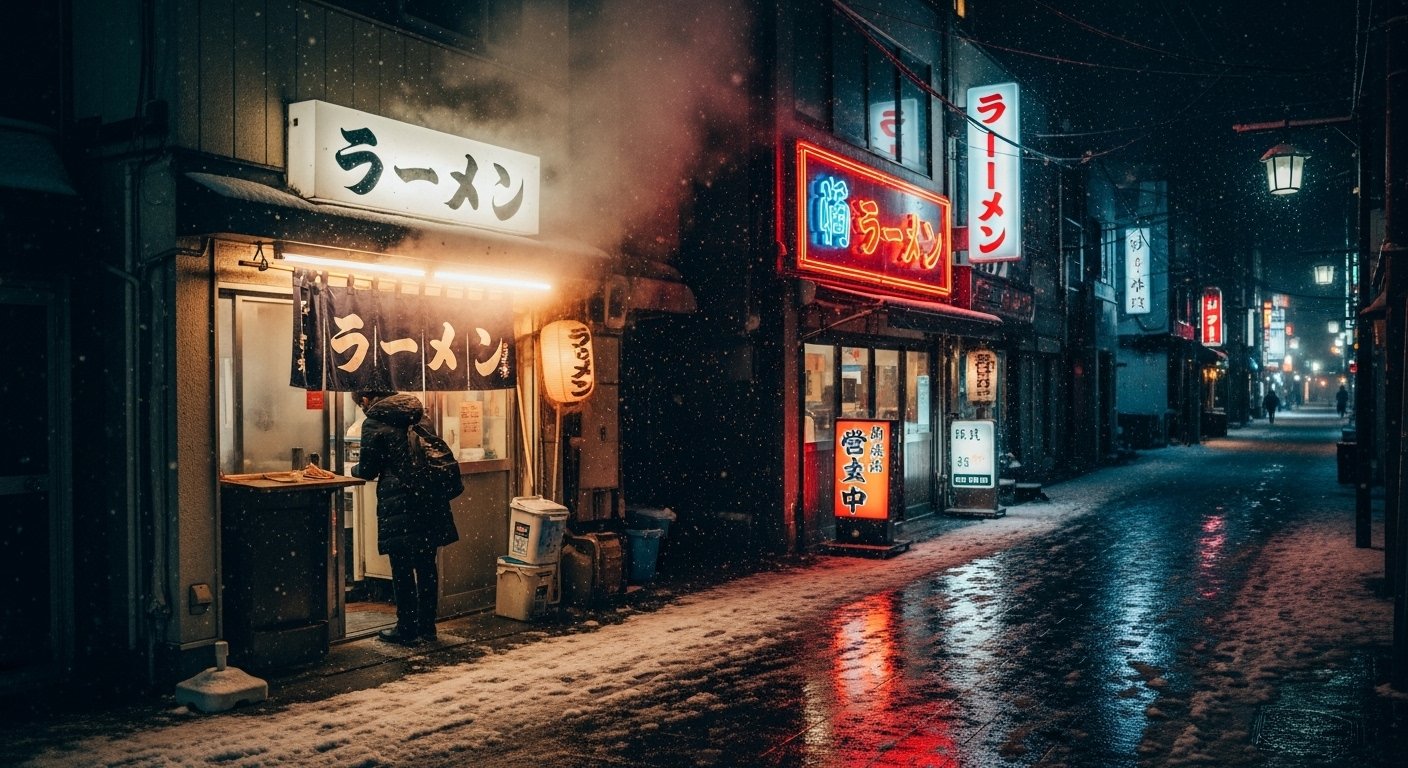
*Images used in this article are for illustration only. They may not be directly related to the content.
Late-Night Winter Warmers: Budget Dinner Ideas After 9 PM in Japan (January)
You’ve just arrived in Japan, or perhaps you’ve been exploring all day. The clock ticks past 9 PM, your stomach rumbles, and the January chill bites. You start looking for dinner, only to find many charming restaurants are already closing their doors. It’s a common travel frustration: how do you find quality, warm, and affordable food late at night in Japan?
Fear not. As your Japan Local Fixer, I understand this exact pain point. Many traditional Japanese eateries and even tourist-focused restaurants indeed operate on earlier schedules, especially outside of bustling entertainment districts. But that doesn’t mean your late-night hunger must go unsatisfied, nor does it mean you need to spend a fortune.
This comprehensive guide will equip you with the practical knowledge, specific locations, and essential phrases to confidently navigate Japan’s late-night dining scene during the cold month of January. We’ll focus on budget-friendly, comforting meals that are easy to access, regardless of your Japanese language proficiency.
Table of Contents
The Late-Night Dining Challenge in Japan
It’s a common scenario for international visitors. You’re out exploring, perhaps enjoying an evening illumination, and suddenly it’s 9 PM or later. Many independent restaurants, especially those specializing in delicate Japanese cuisine, have already closed their kitchens or are preparing for last order. The problem isn’t just about finding any place; it’s about finding somewhere that is:
- Open past 9 PM: Standard closing hours are often earlier than in many Western countries.
- Serving warm, comforting food: January evenings are cold, and a hearty meal is essential.
- Budget-friendly: Travel costs add up, and affordable options are always welcome.
- Accessible despite language barriers: The fear of miscommunication or being turned away is real.
- Easy to navigate: Understanding ordering, etiquette, and payment methods.
This perceived difficulty often leads travelers to settle for less satisfying options or simply go hungry. However, with the right information, you can effortlessly find excellent late-night budget meals.
Your Go-To Late-Night Winter Warmers
When the clock strikes late and the temperatures drop, specific types of establishments consistently deliver. These are your reliable havens for a warm, affordable meal.
Convenience Stores (Konbini): Your 24/7 Lifeline
Japan’s convenience stores — 7-Eleven, FamilyMart, and Lawson — are unparalleled. They are not merely snack shops; they are full-fledged mini-supermarkets and cafeterias rolled into one, operating 24/7 nationwide.
What to look for:
- Oden (おでん): A winter staple. Various ingredients (fish cakes, daikon radish, eggs, konnyaku) simmered in a light dashi broth. It’s hot, comforting, and customizable. Look for a steaming counter near the cashier.
- Fried Chicken & Hot Snacks (フライドチキン, ホットスナック): Freshly fried chicken (like Lawson’s Karaage-kun or FamilyMart’s FamiChiki) is a popular, satisfying snack or light meal. Steamed buns (肉まん – nikuman) are also great for warmth.
- Microwavable Bentos & Prepared Meals (弁当, 総菜): A vast selection of pre-packaged meals, from pasta to curry to grilled fish. Many can be heated in-store by the staff (just say “Ata-tame-te kudasai” – 温めてください – please heat it up).
- Instant Noodles & Soups: An entire aisle dedicated to instant ramen and udon. Most konbini have hot water dispensers, allowing you to prepare a steaming bowl on the spot.
Visual Cue: Look for the brightly lit, distinctive storefronts: red/green/orange for 7-Eleven, green/blue/white for FamilyMart, and blue/white for Lawson. The hot food counter is usually right next to the cash register.
Ease of Use: Simply grab what you want, pay at the counter. Language is rarely an issue here.
Official Links for Konbini:
Gyudon Chains: Fast, Hot, and Budget-Friendly
Gyudon (牛丼), or beef bowl, is a quintessential Japanese comfort food. Thinly sliced beef simmered in a savory-sweet sauce, served over rice. Chains like Sukiya, Yoshinoya, and Matsuya are everywhere, often open 24/7, and incredibly budget-friendly.
What to expect:
- Speed: Food is served minutes after ordering.
- Affordability: A standard gyudon typically costs ¥400-¥700.
- Warmth: Hot rice and beef bowl are perfect for cold nights.
- Variety: Beyond gyudon, they offer curry, pork bowls (butadon), and sets with miso soup and salad.
Visual Cue: Look for large, brightly lit signboards: red for Sukiya, orange for Yoshinoya, and yellow/blue for Matsuya. They often display 24時間営業 (Nijūyojikan Eigyō – 24-hour operation) prominently. Many use ticket vending machines.

Official Links for Gyudon Chains:
Ramen Shops: A Classic Late-Night Comfort
Ramen is a globally recognized dish, and many ramen shops, especially in urban areas, stay open late. A steaming bowl of rich broth, springy noodles, and toppings is ideal for January’s chill.
What to expect:
- Diverse Flavors: From rich tonkotsu (pork bone broth) to lighter shio (salt) or shoyu (soy sauce) bases.
- Customization: Many shops allow you to choose noodle firmness, broth richness, and amount of oil.
- Ticket Machines: Common here, reducing language friction.
Visual Cue: Ramen shops often have strong, distinct aromas spilling onto the street. Look for ticket vending machines at the entrance. Plastic food models (食品サンプル – shokuhin sample) displaying different ramen bowls are also common.
Examples: Larger chains like Ichiran (known for individual booths) and Ippudo often have extended hours, particularly in major cities like Tokyo, Kyoto, and Osaka.

Izakayas: Social & Strategic Budget Options
Izakayas are Japanese gastropubs. While they can be pricier, many offer budget-friendly options, especially if you order strategically.
How to keep it budget-friendly:
- Focus on specific dishes: Karaage (fried chicken), yakitori (skewered grilled chicken), edamame, and various small vegetable dishes are often affordable.
- Set menus: Some izakayas offer late-night set meals that can be a good value.
- Avoid over-ordering drinks: Drinks, especially alcoholic ones, can quickly inflate your bill.
Visual Cue: Look for noren (fabric curtains) and red chochin (paper lanterns) at the entrance. Modern izakayas might have more contemporary signage but usually still display their menu outside.
Availability: Many izakayas operate until midnight or later, especially in entertainment districts.
🎯 Local Pro-Tip: Many izakayas charge a small cover fee (お通し – otoshi) per person, which often includes a small appetizer. This is standard practice and not a scam. If you’re on a tight budget, clarify this before committing.
For more details on izakaya etiquette, consider checking related articles on Japanese dining customs.
[Internal Link Suggestion: “Understanding Japanese restaurant etiquette and customs”]
Standing Soba/Udon Shops (Tachigui Soba/Udon): Quick Warm-Up
These are often found within or near train stations, making them perfect for a quick, warm, and very cheap meal before heading back to your accommodation. They are literally “standing and eating” noodle shops.
What to expect:
- Speed: Order, pay, and your hot bowl of noodles is ready almost instantly.
- Affordability: One of the cheapest hot meals you can find, typically ¥300-¥600.
- Warmth: Steaming hot broth with soba (buckwheat noodles) or udon (thick wheat noodles) is perfect for January.
Visual Cue: Small, often bustling shops, usually with a ticket machine at the entrance and a counter where people stand to eat. They might have simple signs showing “そば” (soba) or “うどん” (udon).
Navigating the Meal: Overcoming Barriers
The thought of ordering in a foreign language can be daunting, but Japan makes it easier than you might think, especially at late-night establishments.
Using Ticket Vending Machines (食券機 – Shokkenki)
Many budget-friendly late-night eateries, particularly ramen and gyudon chains, use ticket vending machines. This system is a blessing for travelers.

- Locate the Machine: These machines are usually near the entrance. They can be large, brightly lit, and often feature pictures of the dishes.
- Look for English: Many modern machines offer an English language option (英語 – Eigo button) or clearly labeled pictures.
- Select Your Dish: Press the button corresponding to your desired meal. Pictures make this straightforward. Some machines show dish names in Romaji or English.
- Pay: Insert cash (yen bills and coins) or use an IC card (Suica, Pasmo, etc. – look for the ICマーク – IC mark). The machine will dispense your ticket(s) and any change.
- Hand Over Ticket: Give your food ticket(s) to the staff, usually at the counter.
- Wait for Your Food: Take a seat (if available) or stand. Your meal will be prepared shortly.
Visual Cue: The machines are hard to miss, often the first thing you see when entering. They usually have large, illuminated buttons with food images.
[Internal Link Suggestion: “How to use food ordering ticket machines in Japan”]
🇯🇵 Point & Speak: Essential Phrases for Late-Night Dining
Don’t be afraid to use these. Most Japanese staff appreciate the effort.
English: What time do you close?
閉店は何時ですか?
(Heiten wa nanji desu ka?)
English: Do you have an English menu?
英語のメニューはありますか?
(Eigo no menyu wa arimasu ka?)
English: One [dish name], please.
〜を一つお願いします。
(~ o hitotsu onegai shimasu. e.g., ラーメンを一つお願いします。)
English: Check, please.
お会計お願いします。
(Okaikei onegai shimasu.)
English: Is this open 24 hours?
24時間営業ですか?
(Nijūyojikan eigyō desu ka?)
English: Takeaway / To go
持ち帰り
(Mochikaeri)
💰 Price Breakdown: What to Expect
Budget-friendly doesn’t mean compromising on taste or warmth, especially with Japan’s excellent value for money.
💰 Price Breakdown (Per Person)
| Meal Type | Estimated Cost (¥) |
| Convenience Store Oden / Hot Snacks | ¥300 – ¥800 |
| Gyudon (Beef Bowl) Chain | ¥400 – ¥800 |
| Ramen Shop | ¥700 – ¥1200 |
| Standing Soba/Udon | ¥300 – ¥700 |
| Strategic Izakaya (light meal + non-alcoholic drink) | ¥1000 – ¥2000+ |
Prices verified as of January 2026. Actual costs may vary by location and specific order.
🎯 Local Pro-Tips for a Smooth Late-Night Meal
🎯 Local Pro-Tip: Use Google Maps Effectively: Before you head out, use Google Maps to search for “restaurants” or specific chains (e.g., “Sukiya”). Filter by “Open Now” and check the actual closing times listed for individual branches. While 24/7 chains are reliable, independent shops may adjust hours seasonally. Cross-reference with official websites if uncertainty persists.
🎯 Local Pro-Tip: Mind the Last Order: Even if a restaurant closes at 10 PM, the “last order” (ラストオーダー – Last Order) is typically 30-60 minutes before closing. Arriving right at closing time means you’ll likely be turned away. Aim to arrive at least an hour before the posted closing time if possible.
🎯 Local Pro-Tip: Check Transportation: While dining late is easy, remember that public transportation (trains and subways) in Japan typically stops around midnight or 1 AM. Plan your return journey to your accommodation in advance to avoid needing an expensive taxi.
[Internal Link Suggestion: “Navigating public transportation schedules for late-night returns”]
Common Mistakes to Avoid
- Assuming all restaurants stay open late: This is the most common pitfall. Many specialty restaurants, especially outside of major entertainment hubs, close by 8-9 PM.
- Ignoring convenience stores: Overlooking konbini means missing out on some of the easiest, warmest, and most budget-friendly late-night food options.
- Not having cash: While card payments are becoming more common, many smaller, late-night eateries or ticket machines still prefer or only accept cash. Always carry some yen.
- Not checking last order times: Showing up 10 minutes before closing time expecting to dine can lead to disappointment.
- Being too timid to use simple phrases or point: Most Japanese staff are accustomed to international visitors and appreciate any attempt to communicate. Visual cues and simple phrases go a long way.
📋 Quick Reference Card
📋 Quick Reference Card: Late-Night Japan Dinner
Screenshot or print this section for easy access:
- ✅ Reliable Options: Convenience stores (7-Eleven, FamilyMart, Lawson), Gyudon chains (Sukiya, Yoshinoya, Matsuya), many Ramen shops, Standing Soba/Udon.
- ✅ Warm Winter Foods: Oden, Ramen, Gyudon, Hot Soba/Udon, Karaage, Nikuman.
- ✅ Budget Expectation: Mostly ¥300 – ¥1200 per person.
- ✅ Overcoming Language: Look for ticket machines with pictures/English, plastic food models, use simple “Point & Speak” phrases.
- ✅ Key Phrase: 英語のメニューはありますか? (Eigo no menyu wa arimasu ka? – Do you have an English menu?)
- ✅ Always Carry: Cash (yen).
Frequently Asked Questions
Are convenience stores in Japan good for dinner?
Yes, Japanese convenience stores (konbini) like 7-Eleven, FamilyMart, and Lawson offer a surprisingly wide selection of high-quality, fresh, and hot meals suitable for dinner. Options include Oden, fried chicken, steamed buns, microwavable bentos, and instant noodles, many of which are perfect for a cold January evening and available 24/7.
How can I find restaurants open after 9 PM in Japan?
Focus on major chain restaurants like Sukiya, Yoshinoya, Matsuya (gyudon), or popular ramen chains, which often have extended or 24/7 hours. Use Google Maps and filter by “Open Now,” checking individual store hours. Look for brightly lit establishments with prominent signs, especially near train stations and entertainment districts.
Is it rude to enter a Japanese restaurant close to closing time?
While not strictly “rude,” it is highly recommended to respect the “last order” time (ラストオーダー – Last Order), which is typically 30-60 minutes before the official closing time. Arriving after last order means the kitchen may have already begun shutting down, and you will likely be politely turned away. Always aim to arrive at least an hour before closing.
Can I use an IC card (Suica/Pasmo) for late-night meals?
Yes, many larger chain restaurants, convenience stores, and ticket vending machines now accept IC cards like Suica or Pasmo for payment. Look for the ICマーク (IC mark) at the payment point or on the vending machine. However, it’s always wise to carry some cash (yen) as backup, especially at smaller, independent establishments.
Conclusion
Don’t let the fear of finding a late-night meal in Japan dampen your January travels. With the right strategy, warm, delicious, and budget-friendly dinner options are readily available. Whether it’s the welcoming glow of a 24/7 konbini, the quick comfort of a gyudon chain, or a steaming bowl of ramen, you’re well-equipped to satisfy your hunger.
Armed with this practical guide, a few key phrases, and an understanding of local options, you can confidently navigate Japan’s culinary landscape, no matter the hour or the temperature. Enjoy your meals!
Further Reading:
- Gurunavi (Restaurant Search with English Filters)
- Tabelog (Restaurant Search – Japanese, useful with translation tools)
Disclaimer
While every effort has been made to ensure accuracy, restaurant operating hours and prices in Japan can change without notice. Always verify information via official websites or Google Maps, especially for independent establishments. Dietary restrictions and allergies should always be communicated clearly; when in doubt, convenience stores offer ingredient lists on packaging.