*Images used in this article are for illustration only. They may not be directly related to the content.
Japan Winter Nomad Survival: Stay Warm, Productive & Budget-Savvy (Jan-Feb 2026)
Venturing to Japan as a digital nomad during January and February presents unique challenges. The appeal of a less crowded season often collides with the reality of colder temperatures, shorter daylight hours, and the struggle to find warm, affordable long-term accommodation. You’re likely concerned about high utility bills, locating suitable heated workspaces with reliable Wi-Fi, and maintaining your focus and mood when the mercury drops.
This guide is your practical resource for navigating Japan’s winter as a remote worker. We provide actionable strategies, local insights, and essential Japanese phrases to help you secure warm lodging, find productive work environments, manage heating costs, and thrive during the coldest months. By the end, you’ll have a clear plan to ensure your winter in Japan is both comfortable and productive.
Table of Contents
- Finding Warm, Affordable Long-Term Stays in Japan Winter
- Securing Heated, Reliable Workspaces in Japan
- Mastering Winter Heating & Utility Costs on a Japan Budget
- Boosting Productivity & Mood Amidst Japan’s Winter
- Navigating Japan’s Winter with Confidence (Language & Culture)
- Frequently Asked Questions
Finding Warm, Affordable Long-Term Stays in Japan Winter
One of the primary concerns for digital nomads in Japan during winter is finding suitable long-term accommodation that balances warmth, cost, and comfort. Standard hotels are often not budget-friendly for extended stays, and traditional Japanese homes can be notoriously cold due to limited insulation.
Weekly/Monthly Apartments (ウィークリーマンション/マンスリーマンション)
For stays longer than a week, look into furnished weekly or monthly apartments from providers like Leopalace21 or Mystays Monthly Residence. These options are designed for short to medium-term rentals and frequently include utilities in the rent, which can significantly simplify budget planning and manage potentially high heating costs.
Leopalace21 offers an English-friendly global site, making direct booking more accessible. Mystays Monthly Residence also provides options, though their Japanese site is more comprehensive. Prices typically range from ¥80,000 to ¥180,000+ per month, varying by city, size, and amenities. Inquire about heating systems and insulation quality before committing.
🎯 Local Pro-Tip: While online platforms are convenient, direct inquiries to local agencies or properties, even with basic Japanese, can sometimes reveal unlisted long-stay discounts or more flexible terms. Be clear about your intended stay duration.
Guesthouses & Hostels with Long-Stay Discounts
Many guesthouses and hostels, particularly in major cities, offer discounted rates for weekly or monthly bookings. These “long-stay plans” (長期滞在プラン, chōki taizai puran) can reduce your per-night cost by 10-30%. While private rooms are available, dorms offer the most budget-friendly option.
The quality of heating can vary significantly in these establishments. It is essential to inquire directly about the heating situation in your specific room or dorm. Some might have central heating, while others rely on individual AC units that double as heaters. Check reviews for mentions of warmth during winter months.

Securing Heated, Reliable Workspaces in Japan
Working remotely in Japan’s winter requires reliable, heated spaces with robust Wi-Fi and power outlets. Relying solely on your accommodation can lead to increased utility bills and potential isolation.
Co-working Spaces (コワーキングスペース)
Co-working spaces are a primary resource for digital nomads. They are prevalent in urban areas and provide a professional, heated environment with consistent Wi-Fi, ample power outlets, and often complimentary coffee or tea. Many co-working spaces in international cities like Tokyo and Osaka cater to foreign visitors, with English-speaking staff and clear signage.
Day passes typically range from ¥1,500 to ¥3,000. For longer stays, monthly memberships (¥10,000-¥30,000+) offer better value and dedicated access. This can be a strategic investment to ensure productivity and warmth.
Coworking Japan is a useful directory to find options across the country.

Internet Cafes / Manga Kissa (ネットカフェ / 漫画喫茶)
Internet cafes and manga kissa are widespread and offer private, heated booths. These are excellent for focused work or emergency warmth. You’ll find powerful Wi-Fi, power outlets, and often free drink bars. Rates are hourly (e.g., ¥300-¥500/hour) or for longer packs, including overnight stays (e.g., ¥1,500-¥3,000). Some even offer shower facilities.
While not a traditional “office” environment, the privacy and guaranteed warmth make them a dependable option, especially for late-night work or when other options are closed.

Public Libraries (図書館) & Cafes
Public libraries in Japan are free, quiet, and reliably heated, offering a peaceful environment for deep work. While Wi-Fi might be limited or require registration, they are excellent for tasks that don’t require constant internet access. Look for signs with ‘図書館’ (toshokan).
Cafes are another common option, though power outlets can be scarce, and Wi-Fi might be less reliable than dedicated workspaces. Always check for the ‘Wi-Fi’ symbol (wavy lines) or ‘電源’ (den-gen – power supply/outlet) sticker on windows or tables.

💰 Price Breakdown: Workspaces
| Item | Estimated Cost (per day/month) |
| Co-working Space (Day Pass) | ¥1,500-¥3,000 |
| Co-working Space (Monthly) | ¥10,000-¥30,000+ |
| Internet Cafe (3 hours) | ¥900-¥1,500 |
| Internet Cafe (Overnight Pack) | ¥1,500-¥3,000 |
| Cafe (coffee cost) | ¥400-¥700 |
| Public Library | Free |
Prices are estimates as of late 2025/early 2026 and can vary by location and provider.
Mastering Winter Heating & Utility Costs on a Japan Budget
High utility bills, especially for heating, are a common pain point in Japan during winter. Traditional Japanese homes often lack comprehensive insulation, making it expensive to heat an entire space using only the air conditioning (エアコン, eakon) unit.
Understanding Japanese Insulation & AC Use
Many older Japanese apartments are not designed for western-style central heating. Air conditioning units, while capable of heating, can consume a lot of electricity when trying to warm a poorly insulated room. Relying solely on these for ambient warmth can lead to surprisingly high bills.
Energy-Efficient Personal Heating Solutions
Focus on personal warmth rather than heating the entire room. This strategy is budget-savvy and effective:
- Electric Blankets (電気毛布, denki mōfu): These are highly energy-efficient for keeping you warm in bed or draped over you while working. They typically cost only ¥0.5-¥2 per hour to run.
- Electric Carpets (電気カーペット, denki kāpetto): Similar to electric blankets but for the floor, providing warmth to your feet and lower body.
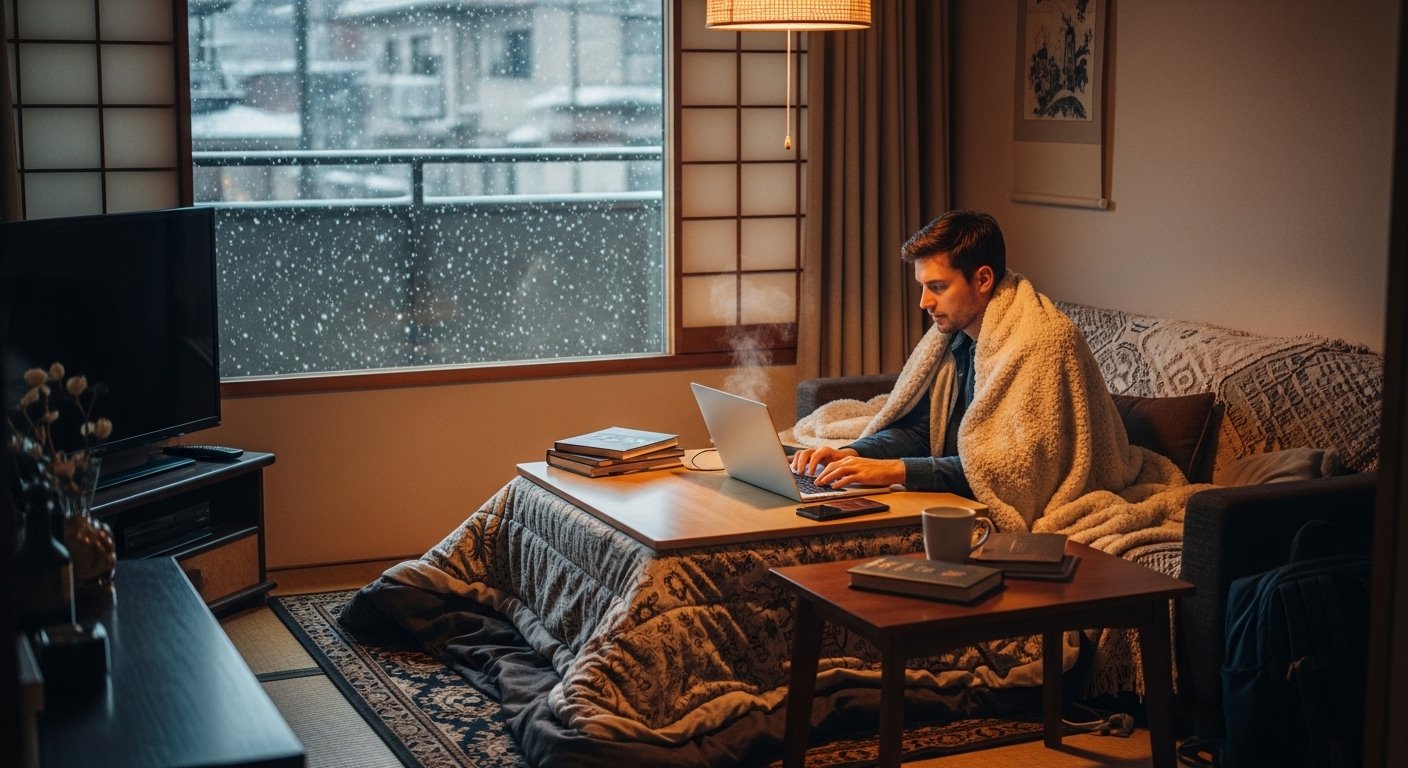
- Kotatsu (こたつ): A low table with a built-in heater and blanket, a traditional Japanese solution. It traps warmth efficiently around your legs and lower body. If your accommodation has one, use it. It’s an incredibly cozy and effective localized heating method.

Kerosene Heaters: A Traditional Option
In some older homes, you might find kerosene heaters (石油ストーブ, sekiyu sutōbu). These offer potent, efficient heat, but they require proper ventilation to prevent carbon monoxide buildup. You’ll need to purchase kerosene (灯油, tōyu) from gas stations (ガソリンスタンド, gasorin sutando) or home centers. Kerosene is typically sold in distinctive red 18-liter plastic tanks (ポリタンク, poritanku). Prices fluctuate but expect around ¥100-¥120 per liter.
🎯 Local Pro-Tip: When using an AC for heating, look for the sun icon or the Kanji ‘暖房’ (danbō) on the remote. Set it to a comfortable but not excessively hot temperature (e.g., 20-22°C/68-72°F) and use personal heating for additional comfort to save energy.

Boosting Productivity & Mood Amidst Japan’s Winter
The lack of natural daylight and persistent cold can impact productivity and mental well-being. Proactive strategies are essential to stay motivated and positive.
Embrace Layering with Heattech
Uniqlo’s Heattech (ヒートテック) thermal wear is widely available and highly effective. It comes in various warmth levels and is indispensable for layering. Wearing Heattech indoors and outdoors allows you to stay warm without overheating your living space, directly contributing to lower heating costs. Stock up on these essentials early in your trip.
Visit Uniqlo’s official website to explore their Heattech range.

Local Warmth: Kotatsu & Onsen
If you have access to a Kotatsu, leverage it. It creates a localized warm bubble perfect for working on a laptop, reading, or simply relaxing. Additionally, Japan’s ubiquitous onsen (hot springs) offer a powerful way to warm up, relax, and combat the winter chill. A visit to an onsen can be a significant mood booster and a unique cultural experience.

Maximize Daylight & Activity
Despite the shorter daylight hours, make an effort to get outside. Even a short walk during the brightest part of the day can help combat seasonal dips in mood. Explore winter festivals (like the famous Sapporo Snow Festival in February) or simply enjoy the crisp winter air. Physical activity helps maintain energy levels and mental clarity.
🎯 Local Pro-Tip: While it’s cold, clear winter days in Japan can be stunning. Seek out views of Mount Fuji or stroll through quieter parks. The absence of summer humidity makes walking more comfortable, provided you’re dressed appropriately.
Navigating Japan’s Winter with Confidence (Language & Culture)
Language and cultural barriers can add to the stress of dealing with practical issues like heating or finding a workspace. A few key phrases and an understanding of visual cues will significantly ease your journey.
🇯🇵 Point & Speak
Show this section to staff if you’re stuck. They can read the Japanese.
English: Do you have Wi-Fi?
Wi-Fiありますか?
(Waifai arimasu ka?)
English: Do you have power outlets?
コンセントありますか?
(Konsento arimasu ka?)
English: I’d like to stay for one month.
一ヶ月滞在したいのですが。
(Ikkagetsu taizai shitai no desu ga.)
English: Do you have a long-stay discount?
長期割引はありますか?
(Chōki waribiki wa arimasu ka?)
English: Is the heating working?
暖房は効いていますか?
(Danbō wa kiite imasu ka?)
English: How much for a day pass?
一日利用だといくらですか?
(Ichinichi riyō da to ikura desu ka?)
English: It’s cold.
寒いです。
(Samui desu.)
English: Where can I buy kerosene?
灯油はどこで買えますか?
(Tōyu wa doko de kaemasu ka?)
Visual Cues: Your Non-Verbal Guide
Beyond phrases, observing visual cues is crucial for navigating daily life:
- Wi-Fi/Power: Look for stickers with the ‘Wi-Fi’ symbol or ‘電源’ (den-gen – power supply/outlet) at cafes or public spaces.
- Workspaces: Co-working spaces often have sleek logos and signs reading ‘コワーキングスペース’ (kowākingu supēsu) or ‘シェアオフィス’ (shea ofisu). Internet cafes will have ‘ネットカフェ’ (netto kafe) or ‘漫画喫茶’ (manga kissa) with bright, sometimes neon, signs.
- Heating: On air conditioning remotes, ‘暖房’ (danbō) is for heating (often with a sun icon), while ‘冷房’ (reibō) is for cooling (snowflake icon).
- Kerosene: Look for distinctive red 18-liter plastic tanks (ポリタンク, poritanku) at gas stations or home centers.

📋 Quick Reference Card: Japan Winter Survival
Screenshot or print this section for easy access:
- ✅ Accommodation: Explore Weekly/Monthly Apartments (Leopalace21, Mystays) or guesthouses with long-stay discounts. Always confirm heating.
- ✅ Workspaces: Utilize co-working spaces or internet cafes for reliable warmth, Wi-Fi, and power. Libraries are free, quiet alternatives.
- ✅ Heating Costs: Prioritize personal heating (electric blanket, Kotatsu) over sole reliance on AC. Layer with Uniqlo Heattech.
- ✅ Mood & Productivity: Get daylight exposure, visit onsen, and stay active.
- ✅ Language: Use provided “Point & Speak” phrases and observe visual cues.
Frequently Asked Questions
Is Japan really that cold in January and February?
Yes, January and February are generally the coldest months across much of Japan. While major cities like Tokyo might not see heavy snow, temperatures often hover around freezing, especially in the mornings and evenings. Regions like Hokkaido and the Japan Sea coast experience significant snowfall. Proper layering and warm accommodation are essential.
How can I find accommodation with good heating?
When booking, specifically ask “暖房は効いていますか?” (Danbō wa kiite imasu ka? – Is the heating working?) or check reviews for mentions of winter comfort. Weekly/monthly apartments often have modern AC units, but insulation varies. Guesthouses may have less robust heating. Prioritize properties built more recently or specifically marketed as “well-insulated.”
Are utility costs much higher in winter?
Yes, heating can significantly increase electricity bills, especially if relying solely on air conditioning in a poorly insulated space. Budget for higher utility expenses if your accommodation does not include them. Utilizing personal heating devices like electric blankets and managing AC use strategically can mitigate these costs.
Can I work effectively in cafes in Japan during winter?
While cafes are an option, they may not always have reliable Wi-Fi or enough power outlets. They are best for short work sessions or tasks that don’t require constant charging. For sustained, focused work, heated co-working spaces or internet cafes offer a more consistent and productive environment.
What clothing is essential for Japan’s winter?
Layering is key. Essential items include thermal base layers (like Uniqlo Heattech), sweaters, a warm, waterproof outer jacket, gloves, a hat, scarf, and waterproof, comfortable shoes. Even indoors, you might want to wear extra layers if your accommodation isn’t consistently warm.
Conclusion
Navigating Japan as a digital nomad in the winter months of January and February demands proactive planning. By leveraging specific accommodation types, identifying suitable workspaces, implementing smart heating strategies, and utilizing practical language tools, you can minimize friction and maximize your productivity and comfort.
Japan’s winter can be a rewarding experience, offering unique cultural events and fewer crowds. With these practical strategies, you are now equipped to stay warm, remain productive, and manage your budget effectively. Embrace the winter, stay savvy, and enjoy your time in Japan.
Disclaimer
The information provided is for general guidance and planning purposes for 2026. Prices and availability of services (accommodation, co-working spaces, utilities) are subject to change and vary by location and time. Always verify current conditions and costs directly with service providers. This guide does not constitute legal, medical, or financial advice. We recommend consulting official sources for visa requirements, local regulations, and safety guidelines.