*Images used in this article are for illustration only. They may not be directly related to the content.
Japan Winter Travel: Conquer Icy Stations & Snow Delays Safely (My 10-Year Fixer’s Guide)
The first time I really felt the brutal reality of a Tokyo winter wasn’t when I saw snow falling, or when I shivered waiting for a bus. No, it was at 6 AM on a Tuesday morning, at Musashi-Kosugi Station, just as the sun was thinking about peaking over the horizon. I was running late for a crucial meeting – the kind where “late” isn’t an option. I bounded up the stairs from the To横線 (Tōyoko-sen) platform, focused purely on making my transfer to the 南武線 (Nambu-sen).
That’s when it happened.
The usually grippy, non-slip texture of the station floor was gone, replaced by a treacherous, nearly invisible sheen of black ice. One moment I was power-walking, the next, my feet shot out from under me like a cartoon character. My backpack went flying, my coffee cup exploded, and I landed squarely on my backside with a sickening thud. The embarrassment burned hotter than the frostbite I was suddenly sure I was getting. Locals, used to the routine, simply picked their way around me. Nobody gawked; they just knew. I lay there for a second, winded, covered in spilled latte, and realized: Japan’s winter transport, while legendary for its efficiency, has its own silent, slippery traps, especially in the early morning.
And that, my friends, is just one of many delightful lessons I’ve learned in my decade here. This isn’t your average fluffy travel guide. This is the down-and-dirty, real-talk survival manual for early morning winter travel in Japan, straight from a fixer who’s fallen, fumbled, and figured it out.
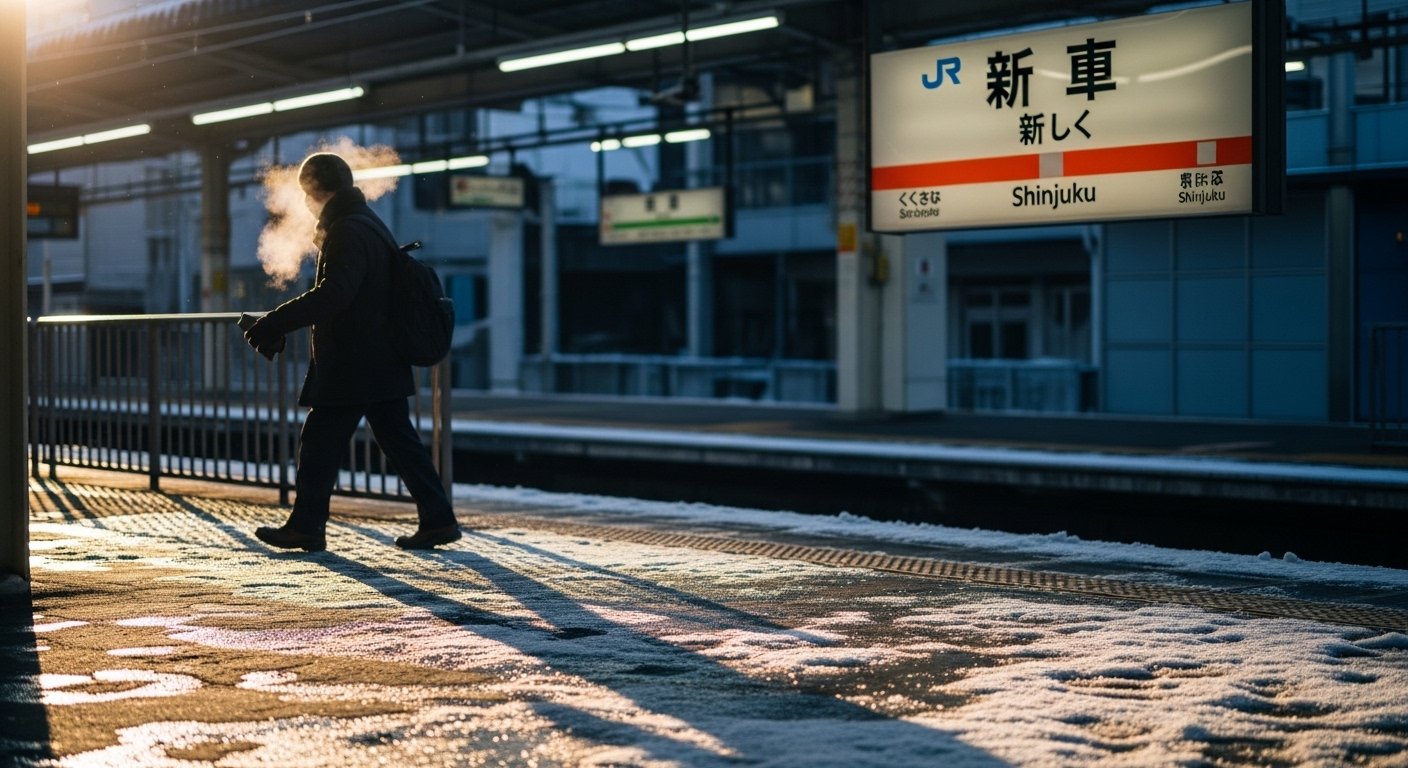
Table of Contents
- The Real Struggle: Why Early Morning Winter Travel in Japan is a Minefield
- Navigating the Ice: Your Survival Guide for Early Morning Stations
- When the Snow Hits: Understanding and Surviving Delays
- Breaking the Language Barrier: Deciphering Announcements & Boards
- Your Digital Lifelines: Finding Real-Time Info & Alternatives
- Price Breakdown: What Unexpected Delays Might Cost You
- Common Pitfalls & How to Avoid Them
- My Final Takeaway: Embrace the Unexpected
- FAQ
The Real Struggle: Why Early Morning Winter Travel in Japan is a Minefield
You’ve heard the stories: Japan’s trains run with surgical precision, arrive to the second, and are the epitome of efficiency. And mostly, that’s true. Until winter decides to throw a wrench into the finely-tuned gears, especially during those pre-dawn, still-dark hours when the world is just waking up, or not quite.
Here’s why it’s genuinely hard, and why your usual travel savvy might not cut it:
- The Invisible Trap: Black Ice: As I learned firsthand, the most dangerous ice isn’t the fluffy snow you can see. It’s the thin, clear sheet that forms when temperatures drop below freezing after a rainy or slushy day. Japan’s stations, with their polished surfaces and tiled walkways, become ice rinks without warning. It’s particularly bad on ramps, stairs, and exposed platforms where the wind can quickly chill surfaces. You’re often moving fast, trying to catch a train, and your eyes are on the schedule, not your feet. It’s a recipe for a nasty spill.
- The Delay Domino Effect: Japan hates delays. Like, passionately. But when snow and ice hit, even the bulletproof Shinkansen can slow down. Regular commuter lines? Forget about it. A tiny flake of snow or a frozen switch on one line can cascade into delays across an entire network. Suddenly, your perfectly planned 30-minute transfer becomes an hour-long wait, and your entire day’s itinerary is thrown into chaos. The stress of missing a connection, an appointment, or even just your breakfast reservation is palpable.
- The Announcer’s Monologue: A Jumble of Japanese: This is a big one. When things go wrong, stations erupt with rapid-fire Japanese announcements. Even if you understand a few key phrases, the specifics of why the delay is happening, how long it will be, or what alternative routes are available, get lost in a torrent of polite but incomprehensible words. I’ve stood there, bewildered, watching locals nod sagely while I just picked up “大変申し訳ございません” (taihen mōshiwake gozaimasen – “we are terribly sorry”) and little else. It’s incredibly isolating.
- Information Overload (in Japanese): While Japan is incredibly tech-savvy, the most up-to-the-minute, detailed information about disruptions often appears first on Japanese-only digital boards, official Japanese websites, or local news channels. Google Maps is great, but it can be slow to update in real-time during major disruptions. Knowing where to look, and how to interpret what you see, becomes a critical skill.
These aren’t just minor inconveniences; they’re genuine friction points that can derail your travel plans and test your patience. But don’t worry, I’m here to arm you with the knowledge I wish I had on that slippery Musashi-Kosugi morning.
Navigating the Ice: Your Survival Guide for Early Morning Stations
My bruised backside taught me a lot that day. Here’s how you can avoid a similar fate:
- Footwear is King (or Queen): This is non-negotiable. Leave your stylish but smooth-soled boots or sneakers at the hotel. You need shoes with good tread. Think hiking boots, winter-specific sneakers, or anything with deep grooves in the sole. I even have a pair of Yaktrax-style slip-on spikes for particularly bad days, especially if I’m heading to a mountainous area like Nagano or Hokkaido.
- The “Penguin Walk”: Seriously, it works. Widen your stance slightly, keep your knees bent, and take shorter, shuffling steps. Keep your center of gravity over your front foot. Avoid quick turns or sudden stops. Focus your gaze about a meter in front of you, looking for any suspicious sheen on the ground.
- Hands Free (or Ready): If you can, keep your hands free. If you have a backpack, wear it properly. If you’re carrying shopping bags, distribute them evenly. This allows you to quickly use handrails or even brace yourself if you start to slip. I usually keep one hand out of my pocket, just in case.
- Identify Danger Zones:
- Stairs and Ramps: These are absolute death traps. Always use handrails. If there are no handrails, take it very slow.
- Platform Edges: Often exposed to the elements, these can be icy. Keep a safe distance from the edge, regardless, but be extra cautious in winter.
- Covered but Unheated Areas: Don’t assume just because it’s under a roof it’s safe. Many station walkways are open-air.
- Transition Points: Where indoor tiles meet outdoor asphalt, or where heated areas meet unheated ones. These are prime spots for ice formation.
- Look for the Salt/Grit: Japanese station staff are diligent, and after snowfall, they often sprinkle salt or a gritty anti-slip material. Look for these darker, rougher patches – they’re your safe zones.
🎯 Insider Tip: Many older, smaller stations, especially those outside major city centers, often have less sophisticated heating or snow removal on platforms and pathways. Prioritize caution there. And if you’re transferring at a massive hub like Shinjuku, try to stick to the main, well-trafficked routes. Sometimes the less-used exits or connecting corridors can be overlooked in the early hours. At Shinjuku, for instance, the underground passages are almost always safer than street-level walkways for avoiding ice.
When the Snow Hits: Understanding and Surviving Delays
I remember one particularly heavy snowfall in Tokyo. Everyone thought the city would shut down. It didn’t, but the trains ground to a crawl. My 30-minute commute turned into a two-hour epic, involving three different transfer attempts and a very cold, very hungry wait.
Japan’s transport is incredibly robust, but even it has limits. Here’s what you need to know about winter delays:
- Why They Happen:
- Frozen Tracks/Switches: Even a small amount of ice can prevent train switches from moving, halting entire lines.
- Snow on Tracks: Heavy snow can build up on tracks, requiring trains to run slower or even stop for plowing.
- Overhead Lines: Ice can form on the overhead power lines, disrupting power collection.
- Door Freezing: Believe it or not, train doors can freeze shut, causing delays at every station.
- Safety Checks: Any unusual weather prompts extra safety checks, which, while necessary, add to delays.
- The “Minor” Delay Trap: Japanese railway companies are notoriously precise. A “5-minute delay” might mean 5 minutes, but during heavy weather, those 5 minutes can stretch into 15, then 30, and then you’ve missed your Shinkansen connection. Always build a buffer into your schedule.
- Don’t Rely on the Schedule: On a normal day, the schedule is gospel. In winter, during a storm, consider it a polite suggestion. The priority shifts from punctuality to safety, meaning trains will often run at reduced speeds.
- What to Do During a Delay:
- Don’t Panic (Easier Said Than Done): Rushing or getting angry won’t help. Take a deep breath.
- Listen and Look: Pay attention to announcements (even if you don’t understand them fully) and look at the digital information boards.
- Consult Your Apps (See next section): Your phone is your best friend here.
- Consider Your Options: Is there an alternative line? Can you switch to a bus or even a taxi (though taxis will be scarce and expensive during bad weather)?
🎯 Insider Tip: If you’re planning a trip that *must* happen (e.g., a flight, an important meeting), always build in at least an extra 30-60 minutes buffer if there’s *any* forecast of snow or freezing temperatures. For critical long-distance travel, consider going the evening before and staying near your departure point, or even booking the first flight/train of the day if delays tend to worsen as the day progresses. And remember, major arterial lines (like the Yamanote Line in Tokyo) often get priority for snow removal and maintenance. Local, less-trafficked lines might suffer more prolonged disruptions.
Breaking the Language Barrier: Deciphering Announcements & Boards
Remember that deluge of Japanese I mentioned earlier? It’s tough. Even after years, I still struggle to catch every nuance in a rapidly spoken, formal announcement. But you don’t need to understand every word; you need to understand the gist and know how to get help.
- Visual Cues First:
- Information Boards: Look for large digital displays. Even if the text is Japanese, key numbers and colors are universal. Red usually means “stopped” or “major delay.” Yellow means “delayed” or “caution.” Green is “normal.” Look for the station names – if yours is missing or highlighted in red, you have a problem.
- Staff Gestures: Station staff are highly trained. If they’re pointing people in a specific direction, or making “stop” motions, follow their lead or approach them cautiously.
- Crowd Movement: The most reliable indicator. If everyone is suddenly leaving a platform, or heading to a different set of stairs, something is definitely up. Follow the crowd, but verify with an app or staff if possible.
- Key Phrases to Look For/Listen For:
- 「遅延」(chien): Delay
- 「運休」(unkyū): Service suspended/canceled
- 「再開見込み」(saikai mikomi): Expected to resume
- 「〇〇時ごろ」(○○ji goro): Around [time]
- 「影響」(eikyō): Impact/effect (e.g., 雪の影響 – yuki no eikyō: “due to snow”)
- 「振替輸送」(furikae yusō): Alternative transport (often a different railway line or bus)
- 「大変申し訳ございません」(taihen mōshiwake gozaimasen): We are terribly sorry (a common phrase during any disruption)
🇯🇵 Point & Speak
Show these to staff:
English: Is the train delayed?
電車は遅れていますか?
(Densha wa okurete imasu ka?)
English: Which platform is this (for my destination)?
[目的地]へは何番線ですか?
([Mokutekichi] e wa nanbansen desu ka?)
English: Where can I find information about alternative routes?
代わりのルート情報はどこですか?
(Kawari no rūto jōhō wa doko desu ka?)
English: I need to go to [Destination].
[目的地]へ行きたいのですが。
([Mokutekichi] e ikitai no desu ga.)
English: Is there a bus?
バスはありますか?
(Basu wa arimasu ka?)
Your Digital Lifelines: Finding Real-Time Info & Alternatives
In the modern age, your smartphone is your ultimate fixer. Forget relying solely on physical maps or limited English signage.
- Google Maps (with a caveat): Google Maps is fantastic for routing, but during major disruptions, it can be a little slow to update. It will often show delays, but might not give you the full picture of why or the best alternative. Still, it’s your go-to for initial routing.
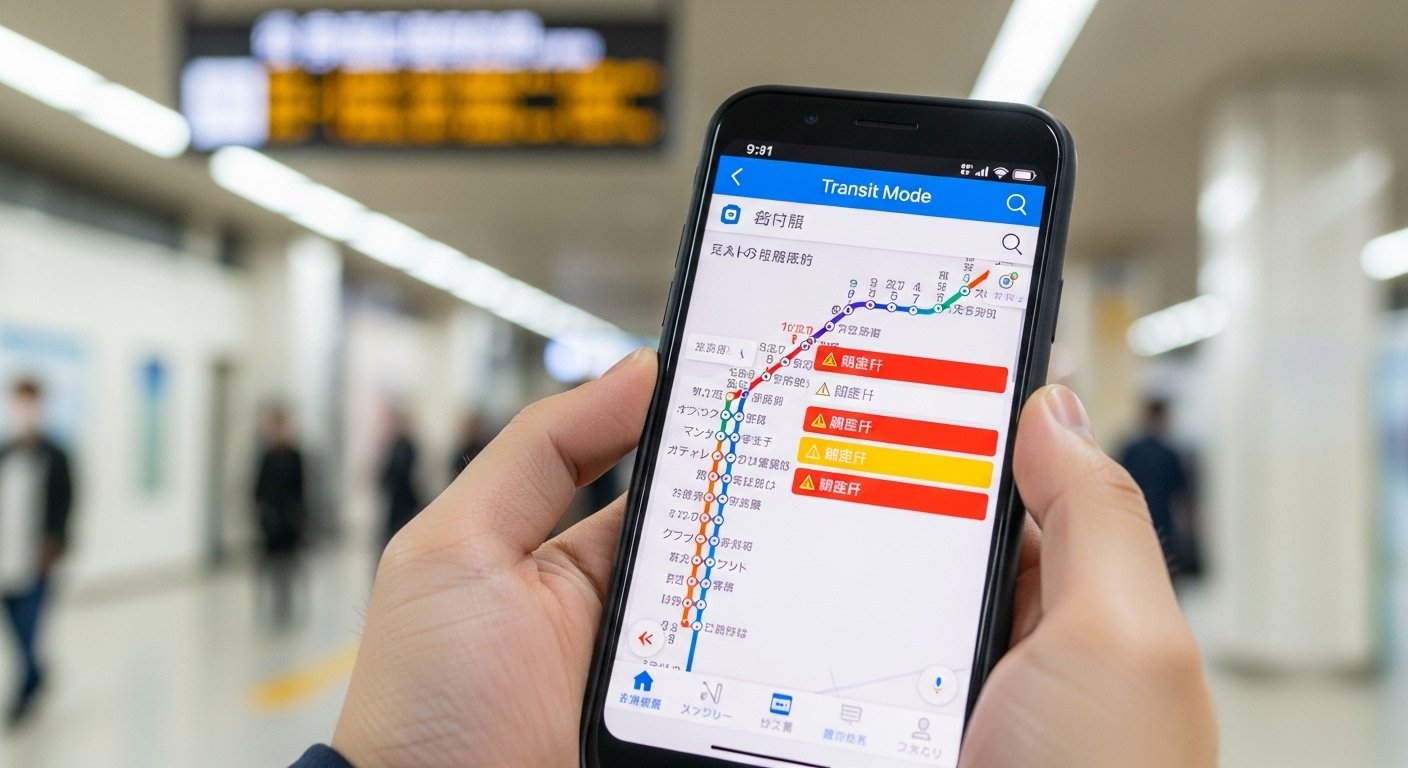
- Japan Transit Planner Apps: These are critical. I personally use “Japan Transit Planner” (by Jorudan) and “Navitime.” These apps are often quicker to reflect real-time delays and can suggest alternative routes across different operators (JR, subway, private lines) more effectively than Google Maps. They often have an English interface.
- How to Use Them:
- Enter your origin and destination.
- Look for colored alerts (red/yellow) next to train lines.
- Crucially, they usually offer an “Alternative Route” button or option if a line is heavily delayed or suspended. Tap it!
- They also show transfer times, which you can then adjust in your head if you know there are delays.
- How to Use Them:
- Official Railway Apps/Websites: For major operators like JR East (JR東日本) or JR West (JR西日本), they have official apps and websites. These are usually in Japanese, but sometimes offer English sections for major service disruptions. If you’re stuck, use Google Translate’s camera function on the Japanese pages. Look for sections titled 「運行情報」(Unkō Jōhō – Operation Information).
- Twitter (X) / Social Media: This might sound chaotic, but during major incidents, locals often tweet real-time updates faster than official channels. Search for hashtags like #運行情報 (unkōjōhō) or the specific line name (e.g., #山手線 for Yamanote Line). Again, Google Translate for tweets is your friend.
- Always Charge Your Phone: This should go without saying, but an uncharged phone in the middle of a winter delay is a recipe for disaster. Carry a portable battery pack.
🎯 Insider Tip: Before you even leave your hotel, open your transit app and check the operational status of your planned lines. Do this even if the weather seems fine – overnight freezing can cause early morning issues. If you see any red or yellow alerts, immediately search for alternative routes or adjust your departure time. Don’t wait until you’re already at the station to find out. Many hotels also have screens in the lobby showing major train line statuses, primarily in Japanese, but often with color coding you can easily understand.
Price Breakdown: What Unexpected Delays Might Cost You
When I talk about “costs,” I’m not just talking about money. Delays in Japan can hit your wallet, your time, and your sanity.
| Type of “Cost” | Description | Estimated Impact (Example) |
|---|---|---|
| **Missed Connection Fee** | If you miss a non-refundable Shinkansen or limited express train ticket due to a local line delay, you might have to buy a new ticket at full price. | ¥3,000 – ¥15,000+ (depending on ticket type and distance) |
| **Taxi Fare Surcharge** | During heavy delays or cancellations, taxis become a scarce and expensive option, especially if you’re trying to reach a distant airport or station. | ¥2,000 – ¥10,000+ (for a 30-min ride outside peak hours, prices surge significantly during delays) |
| **Lost Time / Missed Experience** | Delay means you miss an important appointment, a pre-booked tour, or a specific opening time for a popular attraction. | Irreplaceable; potentially hundreds of dollars in lost tour/ticket fees. |
| **Emergency Food/Drink** | Being stranded for hours, you’ll inevitably buy snacks, drinks, or even a meal at the station. | ¥500 – ¥2,000 per person |
| **Unexpected Accommodation** | In very rare, extreme cases (like a massive, unexpected snowstorm grounding all transport), you might need to find an emergency hotel for the night. | ¥5,000 – ¥20,000+ per night |
| **Stress & Frustration** | The mental toll of uncertainty, language barriers, and disrupted plans can significantly impact your enjoyment of the trip. | Incalculable, but very real. |
While many of these are worst-case scenarios, the point is that being unprepared for winter delays can have tangible financial and emotional consequences. A little preparation goes a long way.
Common Pitfalls & How to Avoid Them
Beyond the main pain points, here are some other traps travelers often fall into during winter in Japan:
- Underestimating the Cold: Especially if you’re coming from a warmer climate, you might think “it’s just Tokyo, how cold can it be?” Very. Sub-zero temperatures are common, and the wind chill can be brutal, particularly on exposed platforms.
- Avoid: Don’t skimp on layers. Thermal underwear, a good quality winter coat, gloves, a scarf, and a hat are essential.
- Assuming English is Available Everywhere: While major stations have some English signage, smaller stations or the specific details of a disruption announcement will likely be in Japanese.
- Avoid: Don’t rely solely on English. Have translation apps ready, know key Japanese phrases, and be prepared to use visual cues.
- Ignoring Early Morning Weather Forecasts: Many people check the weather the night before and assume it will be the same in the morning. Temperatures drop significantly overnight, turning rain into ice.
- Avoid: Check the hourly forecast just before you go to bed, and again when you wake up, paying close attention to temperatures around freezing (0°C/32°F).
- Over-scheduling Your Mornings: Packing too much into your early morning itinerary leaves no room for error.
- Avoid: Build in flexibility. Don’t book unmissable, time-sensitive activities right at the start of the day if there’s any chance of winter weather.
- Not Knowing Your Route’s Alternatives: Many routes have backup options (e.g., a subway line running parallel to a JR line).
- Avoid: Before you travel, quickly scout your main routes on a transit app to see if there are viable alternative lines if your primary one goes down.
My Final Takeaway: Embrace the Unexpected
Living in Japan for a decade has taught me that while meticulous planning is valued, flexibility is king, especially when dealing with Mother Nature. You might have the most detailed itinerary known to man, but a sudden snowfall can force you to pivot.
My advice as your Japan Local Fixer is this: prepare for the worst, hope for the best, and always have a backup plan. Dress warmly, walk carefully, keep your phone charged, and don’t be afraid to ask for help (with a friendly smile and your phrasebook/app ready).
Most importantly, try to embrace the challenge. The chaos of a snow-delayed station, the camaraderie of fellow stranded travelers, the unexpected detours – these are the stories you’ll tell. Japan in winter is magical, but it demands respect and preparation. By understanding the potential pitfalls and arming yourself with these strategies, you won’t just survive; you’ll conquer early morning winter travel, turning potential stress into just another part of your unique Japanese adventure.
FAQ
How can I best avoid slipping on icy platforms and station areas in Japan?
The most effective way is to wear appropriate footwear with excellent tread, like hiking boots or winter-specific sneakers. Adopt a “penguin walk” – taking short, shuffling steps with slightly bent knees to maintain your balance. Always use handrails on stairs and ramps, and be extra cautious at transition points between indoor and outdoor areas. Look for patches of salt or grit, which indicate safer walking zones. Avoid rushing at all costs, especially in the early morning when ice formation is most prevalent.
What should I do if my train or bus is unexpectedly delayed due to winter weather in Japan?
First, don’t panic. Immediately check your Japan transit planner apps (like Japan Transit Planner or Navitime) for real-time updates and potential alternative routes. Pay attention to digital information boards and observe how locals are reacting or moving. If you need to speak to staff, have a few key Japanese phrases ready, or use a translation app. If you have critical connections, re-evaluate your itinerary and be prepared for potential costs like buying new tickets or taking an expensive taxi if absolutely necessary.
How can I understand Japanese announcements about service disruptions if I don’t speak the language?
Focus on visual cues first: look at digital information boards for colored alerts (red/yellow for delays/cancellations) and watch the movement of the local crowd. Key Japanese phrases to recognize include 「遅延」(chien – delay), 「運休」(unkyū – suspended/canceled), and 「振替輸送」(furikae yusō – alternative transport). Keep a translation app handy for longer texts, and use the “Point & Speak” phrases provided in this guide to ask station staff for clarification. They might not speak fluent English, but they can often point you in the right direction or write down key information.


