*Images used in this article are for illustration only. They may not be directly related to the content.
Warm & Wallet-Friendly Japan Winter Workspaces: Beat the Cold, Boost Productivity
Winter in Japan brings its own charm, but for international residents and digital nomads, it also presents a specific challenge: staying warm and productive without excessive heating costs. Japanese apartments, particularly older ones, are not always built for insulation, leading to chilly indoor temperatures and daunting utility bills if you heat your entire living space all day. You’re looking for practical solutions to work comfortably, affordably, and perhaps even find a new community.
This guide cuts through the noise, offering direct, actionable strategies for finding warm, reliable, and budget-friendly workspaces across Japan. Whether you need a focused environment, a place to connect, or simply a warm spot to call your temporary office, we’ll help you navigate your options and keep your productivity—and your comfort—high during the colder months.
Table of Contents
- The Winter Challenge: Cold Apartments, High Bills, and Isolation
- External Warm Workspaces: Your Public Options
- Cozy Productivity at Home: Localized Heating Solutions
- 🇯🇵 Point & Speak: Essential Japanese Phrases
- 📋 Quick Reference Card: Japan Winter Workspaces
- Frequently Asked Questions
- Conclusion: Stay Warm, Stay Productive
- Disclaimer
The Winter Challenge: Cold Apartments, High Bills, and Isolation
Many apartments in Japan are designed to cool down quickly in summer, but this efficiency works against you in winter. Poor insulation, single-pane windows, and reliance on electric air conditioners for heating can lead to a constant chill indoors and shockingly high utility bills. Working from home under these conditions can be uncomfortable, inefficient, and expensive.
Beyond the temperature, the lack of suitable, affordable workspaces with reliable Wi-Fi and power outlets can hinder your productivity. Staying indoors constantly can also contribute to feelings of isolation or “winter blues.” The good news is, Japan offers several practical, warm, and wallet-friendly alternatives to keep you comfortable and connected.
External Warm Workspaces: Your Public Options
Stepping out of your chilly apartment into a dedicated workspace can dramatically improve your winter productivity. Here are your best options for warm remote work in Japan.
Internet Cafes (Net Cafe / Manga Kissa): Your 24/7 Warm Hub
Internet cafes are a cornerstone of affordable, warm, and amenity-rich working in Japan. They are much more than just places to check email; many offer private booths, comfortable seating, reliable Wi-Fi, power outlets, and often complimentary drinks.
Visual cue: Look for large, brightly lit signs featuring names like 快活CLUB (Kaikatsu CLUB), 自遊空間 (Jiyuukuukan), or カスタマカフェ (Customa Cafe). You’ll often see the kanji ネットカフェ (netto kafe) or 漫画喫茶 (manga kissa) prominently displayed, usually near train stations in urban and semi-urban areas, often in multi-story buildings.
💰 Price Breakdown: Internet Cafes
| Service | Cost Estimate |
| Hourly Rate | ¥300-600 |
| 3-Hour Pack | ¥900-1500 |
| 6-Hour Day Pack | ¥1500-2500 |
| Night Pack (6-10 hours) | ¥1800-3000 |
| Membership Fee (one-time) | ¥0-300 |
Prices verified as of January 2026. Note: Specific chain and location pricing varies.
🎯 Local Pro-Tip: Always opt for a multi-hour pack if you plan to stay longer than 2 hours; it’s significantly more cost-effective. Many chains require a free or low-cost membership. Bring your passport for ID verification if you are not a Japanese national.
Internet cafes often operate 24/7, providing unparalleled flexibility for your schedule. Some even offer showers, making them a true budget solution for a warm, comfortable space.
Common Mistakes to Avoid:
- Not bringing ID: You will likely be refused service without a valid form of identification like your passport or residence card.
- Paying hourly for long stays: The hourly rate adds up quickly. Always ask for longer packs (パック – pakku).
- Expecting perfect silence: While private, soundproofing varies. Bring noise-canceling headphones for video calls or deep focus.
Co-working Spaces: Professional Warmth and Community
For a more dedicated and professional environment, co-working spaces are an excellent choice. They offer reliable amenities and often a community aspect, combating winter isolation. These are concentrated in major cities like Tokyo, Osaka, and Fukuoka, but are also emerging in regional centers.
Visual cue: Co-working spaces typically feature modern, minimalist signage, often incorporating “COWORKING SPACE” in English or the katakana コワーキングスペース. Look for logos with laptops, Wi-Fi symbols, or contemporary fonts, usually found within office buildings or renovated commercial spaces.
💰 Price Breakdown: Co-working Spaces
| Service | Cost Estimate |
| Hourly Rate | ¥300-800 |
| Daily Drop-in | ¥1000-2000 |
| Monthly Membership (basic) | ¥10,000-30,000+ |
Prices verified as of January 2026. Premium spaces like WeWork will be higher.
🎯 Local Pro-Tip: Many co-working spaces offer a free trial day or discounted first-time use. This is a good way to test the environment before committing. Look up chains like BasisPoint (basispoint.tokyo) or use aggregator sites like coworking-space.jp (coworking-space.jp) to find local options.
While usually more expensive than internet cafes, co-working spaces offer a higher standard of amenities, including ergonomic chairs, meeting rooms, and often complimentary coffee. Operating hours are typically 9:00-21:00, with 24/7 access for some members.

Chain & Independent Cafes: Casual Warmth with a Catch
Chain cafes like Starbucks, Tully’s, Doutor, and Komeda’s Coffee are ubiquitous and provide instant warmth. Many offer free Wi-Fi and some power outlets, making them a popular choice for short work sessions.
Visual cue: You’ll recognize international chain logos. For power outlets, look for small stickers or signs on tables displaying 電源 (dengen – power outlet) or “Free Wi-Fi” symbols. Independent cafes will vary, but often have a cozier, more unique aesthetic.
💰 Price Breakdown: Cafes
| Item | Cost Estimate |
| Coffee/Tea | ¥300-600 |
| Pastry/Light Meal | ¥300-800 |
| Cost for a 4-hour stay (assuming 2 purchases) | ¥600-1600 |
Prices verified as of January 2026.
🎯 Local Pro-Tip: While acceptable for an hour or two, it’s generally expected to make repeat purchases for extended stays in a cafe. For long work sessions, cafes become less wallet-friendly compared to internet cafes or co-working spaces. Arrive early to secure a seat with a power outlet.

Public Libraries (Toshokan): Free, Quiet Warmth
Public libraries are a fantastic, free option for focused, silent work. They are well-heated, provide ample desk space, and are available in almost every city and town. They are ideal for reading, writing, or tasks that don’t require active verbal communication.
Visual cue: Public libraries are usually substantial public buildings marked with the kanji 図書館 (toshokan). They often feature distinctive modern or civic architecture. Inside, look for designated study areas or desks.
🎯 Local Pro-Tip: Libraries are excellent for deep work but are not suitable for video calls or any form of verbal remote work. Wi-Fi and power outlets might be limited or restricted to specific areas, so check in advance. You can often find your local library via the Japan Library Association website (jla.or.jp/library/).

Community Centers (Kōminkan): Local, Budget-Friendly Warmth
Community centers are local public facilities offering various services, including meeting rooms and study spaces. They are often free or very low cost, providing a warm place to work, especially in smaller towns or neighborhoods.
Visual cue: Community centers are typically marked with 公民館 (kōminkan). Their appearance can vary greatly, from older, functional buildings to newer, multi-purpose facilities, often with local informational posters outside.
🎯 Local Pro-Tip: Amenities like Wi-Fi and power outlets vary significantly by location and may not be reliable or available for general use. It’s best to inquire directly at your local center. This option is most suited for quiet tasks that don’t heavily rely on internet connectivity.

Cozy Productivity at Home: Localized Heating Solutions
If leaving home isn’t always an option, you can still create a warm and productive workspace within your apartment without heating the entire unit. These solutions target warmth directly to you, saving on electricity or gas bills.
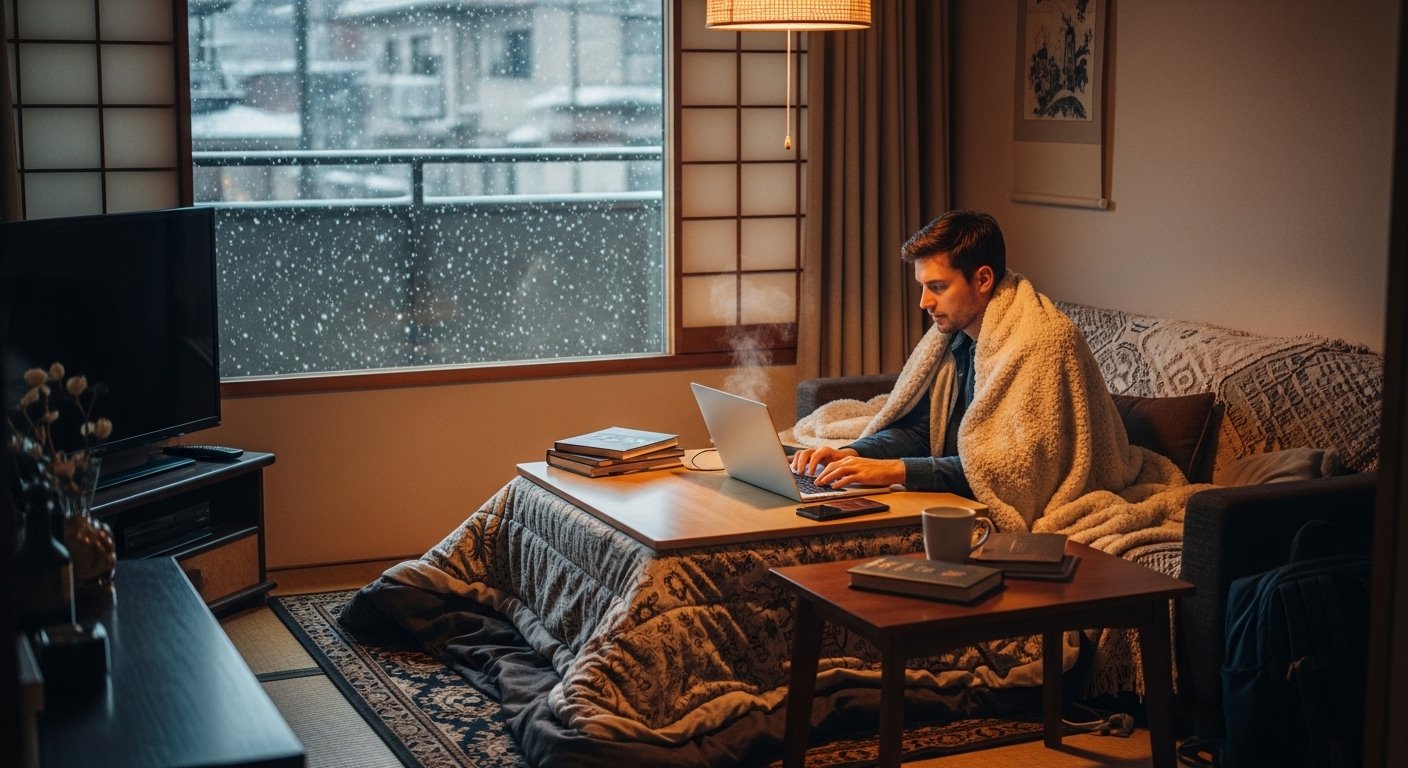
- Kotatsu (こたつ) and Electric Carpets (電気カーペット): These Japanese inventions are energy-efficient champions. A kotatsu is a low table with a heater underneath and a heavy blanket draped over it, trapping warmth. An electric carpet provides warmth underfoot. Both are excellent for keeping your core and extremities warm while working from a specific spot.
- Kerosene Fan Heaters (石油ファンヒーター): Common and often cost-effective, these heaters quickly warm a single room. Kerosene can be purchased at gas stations or home centers (e.g., Cainz Home, Kohnan).
🎯 Local Pro-Tip: When using kerosene heaters, ensure regular ventilation to prevent carbon monoxide buildup. Open a window for a few minutes every hour. Always purchase kerosene from official retailers to ensure quality and safety.


Combining these localized heating methods with warm clothing (e.g., Uniqlo HEATTECH) can make your home workspace comfortable and your utility bills manageable.
🇯🇵 Point & Speak: Essential Japanese Phrases
Navigating new spaces is easier with a few key phrases. Show this section to staff if you’re stuck; they can read the Japanese.
🇯🇵 Point & Speak
Show this section to staff if you’re stuck. They can read the Japanese.
English: Do you have Wi-Fi?
Wi-Fiありますか?
(Wi-Fi arimasu ka?)
English: Can I use a power outlet?
電源は使えますか?
(Dengen wa tsukaemasu ka?)
English: I’d like to use it for a long time.
長時間利用したいのですが。
(Chōjikan riyō shitai no desu ga.)
English: Is there a quiet seat?
静かな席はありますか?
(Shizuka na seki wa arimasu ka?)
English: I’d like to become a member.
会員になりたいのですが。
(Kaiin ni naritai no desu ga.)
English: Do I need ID?
身分証明書は必要ですか?
(Mibun shōmeisho wa hitsuyō desu ka?)
📋 Quick Reference Card: Japan Winter Workspaces
📋 Quick Reference Card
Screenshot or print this section for easy access:
- ✅ Internet Cafes: 24/7, private booths, cheapest for long stays.
Need ID for membership. Best for focused work, sometimes loud. - ✅ Co-working Spaces: Professional, community, good amenities.
Higher cost, ideal for networking. Check for trial days. - ✅ Cafes: Ubiquitous, casual.
Good for short sessions, can get expensive for long stays. Power outlets limited. - ✅ Public Libraries: Free, quiet, warm.
No video calls. Limited Wi-Fi/power. Ideal for silent study. - ✅ Community Centers: Very low cost, local.
Amenities vary. Best for basic, offline work. Inquire locally. - ✅ At Home (Localized Heating): Kotatsu, electric carpets, kerosene heaters.
Cost-effective, comfortable. Kerosene needs ventilation.
Frequently Asked Questions
Can I work from a convenience store (konbini) in Japan?
No, Japanese convenience stores are not designed as workspaces. While they have seating areas, they are for quick snacks or breaks, not extended work sessions. Most do not offer Wi-Fi or power outlets, and it’s not customary to linger.
Is public Wi-Fi reliable for remote work in Japan?
Wi-Fi in Japan is generally good, but public free Wi-Fi (like municipal networks or some cafe options) can be inconsistent or have data caps. For reliable remote work, especially video calls, opt for dedicated workspaces like internet cafes or co-working spaces, which provide stable, high-speed connections.
Do I need to speak Japanese to use these workspaces?
Basic Japanese phrases (like those in our “Point & Speak” section) are helpful, but often not strictly necessary. Staff at major internet cafe chains or co-working spaces in larger cities may have some English proficiency. Visual cues, translation apps, and polite gestures can also help you communicate your needs.
How do I find the nearest warm workspace in my area?
Google Maps is your best tool. Search for “ネットカフェ” (net cafe), “漫画喫茶” (manga kissa), “コワーキングスペース” (co-working space), or “図書館” (toshokan – library) in your current location. Check their official websites for detailed information on amenities and pricing. For chain cafes, simply search for their English names.
Conclusion: Stay Warm, Stay Productive
Don’t let Japan’s winter chill disrupt your productivity or impact your well-being. By exploring the range of warm, wallet-friendly workspaces available, you can stay comfortable, focused, and connected. From the 24/7 convenience of internet cafes to the professional environment of co-working spaces, or the localized warmth of home solutions, there’s an option to suit every need and budget.
Embrace these resources, combat the cold, and keep your digital nomad journey in Japan productive and enjoyable. Your comfort and work efficiency don’t have to suffer during the colder months; practical solutions are readily available.
Disclaimer
Prices and operating hours are subject to change. Always verify information directly with the service provider before planning your visit. This guide provides general advice for international visitors and residents in Japan; individual circumstances and local regulations may vary. Local inquiry is always recommended for the most current and accurate information, especially regarding public facilities like libraries and community centers. While we aim for accuracy, we cannot be held responsible for any discrepancies.